Flying a drone offers unparalleled perspectives and opens up a world of creative possibilities, but what happens when the elements turn against you? Strong winds, the silent adversaries of stable flight, can quickly transform an enjoyable aerial mission into a nerve-wracking ordeal, or worse, lead to the loss of your precious equipment. For any drone pilot, understanding how to navigate breezy conditions safely and effectively is not just a skill—it’s a necessity. This comprehensive guide will equip you with the knowledge and techniques to confidently fly your drone, even when the wind tries to push you off course.
Understanding Drone Wind Resistance: What You Need to Know
Before you even consider launching your drone into a gusty sky, it’s crucial to understand its inherent capabilities. Every drone has a specified wind resistance rating, a key indicator of its ability to maintain stability and respond to commands when faced with aerial currents.
What Defines a Drone’s Wind Resistance?
|
Our Picks for the Best Drone in 2026
As an Amazon Associate I earn from qualifying purchases.
|
||
| Num | Product | Action |
|---|---|---|
| 1 | GPS Drones with Camera for Adults 4K, FPV Drone Under 249g with Brushless Motor, GPS Auto Return, Follow Me, Circle Fly, Waypoint Flight, Foldable Drone with Gesture Control, 46Mins with 2 Batteries |

|
| 2 | DJI Mini 4K Camera Drone Combo, Drone with 4K UHD Camera for Adults, Under 249 g, 3-Axis Gimbal Stabilization, 10km Video Transmission, Auto Return, 2 Batteries for 62-Min Max Flight Time, QuickShots |
|
| 3 | Drone with Camera for Adults 4K, Brushless Motor Drones for Kids Beginners, 60 Mins Flight, 130° Lens, FPV Foldable RC Quadcopter, Gesture Photography, Toys Gifts for Teen Boys Girls, Black |
|
| 4 | Drone with 1080P Camera - Foldable Remote Control Quadcopter with Gesture Control, 3D Flip, One Key Start, Emergency Stop, 2 Batteries, Easier to use, Toy for Kids Adult Beginners |
|
| 5 | DJI Air 3S Fly More Combo (RC 2 Screen Remote Controller), Drone with 1" CMOS Wide-Angle & Medium Tele Camera for Adults, 4K/60fps, Omnidirectional Sensing & 3 Batteries for Extended Flight Time |
|
| 6 | DJI Mini 3 Fly More Combo (DJI RC), Drones with Camera for Adults 4K, 3 Batteries for 114-min Flight Time, Vertical Shooting, 32800ft (10km) Video Transmission, Lightweight Mini Drone for Beginners |
|
| 7 | Drone with Camera, Drones for Adults and Beginners, 1080P HD FPV Foldable Mini Drones for Kids, with 2 Batteries, Carrying Case, Trajectory Flight, Gravity Control, One-Key Takeoff/Landing, 360° Flip, Toys for Gift |
|
| 8 | Drone with Camera - Drone with Screen on Controller for Beginners, Foldable Remote Control Quadcopter with Gesture Control, 3D Flip, One Key Start, Emergency Stop, 2 Batteries, Easier to use to use |
|
| 9 | Drone with Camera 1080P HD FPV Foldable Mini Drone for Beginners Kids Adults, Drone with One Key Take Off/Landing, Gesture Selfie, Altitude Hold, 3D Flip, Easy to Fly, 2 Batteries, Toys for Boys Girls |
|
| 10 | DJI Mini 4K, Drone with 4K UHD Camera for Adults, Under 249 g, 3-Axis Gimbal Stabilization, 10km Video Transmission, Auto Return, Wind Resistance, 1 Battery for 31-Min Max Flight Time, Intelligent |
|
Drone manufacturers typically rate their products’ wind resistance using a scale from 0 to 12, often corresponding to the internationally recognized Beaufort Wind Scale. This scale categorizes wind speeds based on their observed effects, offering a universal language for pilots. A higher number on this scale signifies greater resilience to strong winds, meaning the drone can hold its position and fly steadfastly through more challenging conditions. For instance, a drone with a Level 6 rating can generally handle winds of about 12-14 meters per second (27-31 mph or 43-50 kph). [cite: 1 (from drone wind resistance ratings explained)]
While some manufacturers explicitly state a “Level X” rating, others might provide the maximum sustained wind speed in meters per second (m/s) or miles per hour (mph) that the drone can withstand. Converting these numbers to a familiar scale allows you to accurately match your drone’s capabilities with real-time weather reports, helping you decide if it’s safe to fly. Industrial-grade drones are typically engineered for much higher wind resistance, capable of operating in conditions that would easily overwhelm most consumer models.
The “Two-Thirds Rule” for Safe Drone Flight
A fundamental safety principle for drone pilots in windy conditions is the “two-thirds wind rule.” This guideline advises that you should only operate your drone when the current wind speed is below two-thirds of your drone’s maximum forward speed or its rated wind resistance. For example, if your drone boasts a top speed of 45 mph, it’s prudent to avoid flying in winds exceeding 30 mph. Ignoring this rule significantly increases the risk of losing control, experiencing uncontrolled drift, or even a crash. [cite: 2 (from safe wind speed for drone flight), 5 (from safe wind speed for drone flight)] Always consult your drone’s specifications and err on the side of caution to protect your investment and ensure a safe flight.
Pre-Flight Wind Assessment: Your Essential Checklist
Successful drone flight in windy conditions begins long before takeoff with a thorough pre-flight wind assessment. Neglecting this crucial step is a common pitfall that can lead to disastrous outcomes.
Harnessing Technology: Weather Apps for Pilots
Don’t rely solely on a general weather forecast from your local news channel. Dedicated drone weather apps offer granular data essential for safe operation. Applications like UAV Forecast are indispensable tools, providing detailed wind profiles at various altitudes, gust speeds, and even “fly/no-fly” recommendations tailored for drone pilots. [cite: 1 (from how to fly drone in strong winds tips), 3 (from how to fly drone in strong winds tips)] Always cross-reference information from multiple sources to get the most accurate picture of the prevailing conditions.
Beyond the Forecast: Visual Checks and Gust Awareness
Even with the best apps, a visual check of your flight environment is paramount. Observe flags, tree branches, and smoke to confirm that the real-world wind conditions align with the forecast. Pay close attention to gust speed rather than just the average wind speed, as sudden, powerful gusts are often the primary cause of drone crashes. These unpredictable bursts of wind can quickly destabilize your drone, especially at higher altitudes or near obstacles. [cite: 3 (from how to fly drone in strong winds tips)] Remember that wind speeds can vary significantly at different altitudes, often increasing with height.
Mastering Takeoff and Landing in Breezy Conditions
Takeoff and landing are the most vulnerable phases of any drone flight, particularly when wind is a factor. Proper technique and strategic positioning can make all the difference between a smooth operation and a challenging one.
Strategic Takeoffs: Shelter and Orientation
When preparing for takeoff in windy conditions, always seek out sheltered locations. Launching from behind a building, a cluster of trees, or a wall can provide a crucial buffer against direct wind forces, allowing your drone to ascend more smoothly. [cite: 1 (from how to fly drone in strong winds tips), 2 (from how to fly drone in strong winds tips)] Furthermore, position your drone so that its camera faces directly into the wind direction. This orientation helps the drone maintain stability during its initial ascent by effectively “leaning” into the wind. If you opt for a hand launch, hold the drone level, with its camera pointed into the wind, and avoid any tilting that could cause instability upon release. [cite: 1 (from how to fly drone in strong winds tips), 5 (from how to fly drone in strong winds tips)]
Smooth Landings: Control and Safety
Landing a drone in windy weather often presents greater challenges than takeoff. Just as with launching, a sheltered spot is ideal for descent. Aim for a stable landing platform and orient your drone into the wind as it approaches the ground. Hand catching can be a safer alternative if you’re comfortable and skilled. To do this, hover the drone directly above you at a safe height, then carefully grab its underside while keeping your hand steady. Always wait for the propellers to come to a complete stop before moving the drone. [cite: 1 (from how to fly drone in strong winds tips)] Practice these techniques in calmer conditions first to build confidence and muscle memory.
In-Flight Strategies for Maintaining Drone Stability in Wind
Once your drone is airborne, specific flight strategies become essential to counteract the wind’s influence and maintain optimal control and battery life.
Battling Headwinds: Flight Path and Battery Management
A critical strategy for windy flights is to fly against the wind on your outbound journey. This allows you to gauge how much battery power is consumed while battling the most challenging conditions. On the return trip, the wind will then assist your drone, making the journey home less power-intensive. [cite: 1 (from how to fly drone in strong winds tips), 3 (from how to fly drone in strong winds tips), 5 (from how to fly drone in strong winds tips)]
Wind significantly accelerates battery drainage. Therefore, you should adjust your return-to-home (RTH) battery percentage to be higher than usual—for example, plan to return when your battery reaches 40% instead of the typical 30%. [cite: 1 (from how to fly drone in strong winds tips), 3 (from how to fly drone in strong winds tips)] This safety margin accounts for the increased energy required to combat headwinds, ensuring your drone has ample power to make it back safely. It’s also wise to shorten your overall flight distance and duration in windy conditions. [cite: 4 (from how to fly drone in strong winds tips)]
Optimizing Control: Altitude and Flight Modes
Flying at lower altitudes, closer to the ground, can help reduce the impact of wind, as ground-level turbulence is often less severe than higher-altitude currents. [cite: 2 (from how to fly drone in strong winds tips)] Maintaining a visual line of sight with your drone is particularly important in strong winds, as GPS signals can sometimes become less reliable, making visual tracking your primary means of control. [cite: 4 (from how to fly drone in strong winds tips)]
Furthermore, adopting smooth, deliberate stick movements rather than sudden, jerky inputs can significantly improve stability. If your drone offers a “Sport Mode” or similar high-performance setting, activating it can provide the extra power and responsiveness needed to fight against stronger gusts. Some advanced pilots might also leverage “Attitude Mode” (ATTI mode) for more direct control without GPS stabilization, though this requires significant skill and is not recommended for beginners in windy conditions. [cite: 5 (from how to fly drone in strong winds tips)]
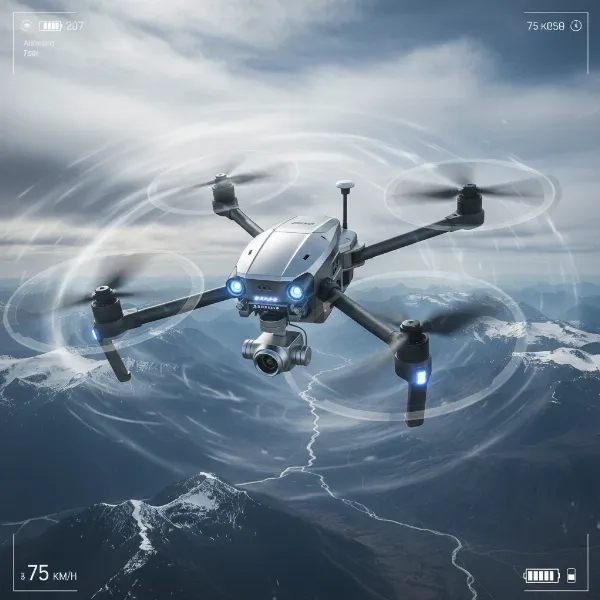 A robust drone maintaining stable flight against strong winds, showcasing its wind resistance capabilities.
Common Drone Models and Their Wind Resistance
The market offers a wide array of drones, each with varying degrees of wind resistance tailored to different purposes and price points. Understanding these general categories can help set realistic expectations for flying in windy conditions.
Most consumer-grade drones, often characterized by their portability and user-friendliness, are typically designed to operate safely in winds ranging from 10-20 mph. These include popular series like the DJI Mini (known for its compact size) and many mid-range models. While impressive for their size, their lighter weight means they will struggle significantly in stronger gusts. Professional and industrial drones, such as certain DJI Mavic series models (e.g., Mavic 3 Pro and Air 3 with reported resistance of 12 m/s or 26-27 mph) [cite: 3 (from safe wind speed for drone flight)] or specialized heavy-lift platforms, are built with more powerful motors, heavier frames, and advanced stabilization systems, allowing them to handle sustained winds of 25-35 mph or even higher. When choosing a drone, always check the manufacturer’s official specifications for its maximum wind resistance rating to ensure it meets your operational needs.
Risks and Precautions: When Not to Fly Your Drone
Despite all the techniques and technological advancements, there are times when discretion is the better part of valor. Knowing when not to fly is as important as knowing how to fly.
The Dangers of Exceeding Wind Limits
Attempting to fly your drone in winds that exceed its rated limits is a gamble with potentially severe consequences. The risks extend far beyond mere inconvenience, encompassing everything from shaky, unusable footage to the complete loss of your drone. Strong winds can overwhelm the drone’s motors, causing it to drift uncontrollably, potentially out of visual line of sight and beyond recovery. This can lead to costly physical damage, or worse, create safety hazards if the drone crashes in populated areas or near property. [cite: 3 (from how to fly drone in strong winds tips)] Wind can also push drones into unexpected obstacles, leading to collisions that can damage both the drone and its surroundings.
Understanding Microbursts and Unexpected Gusts
One of the most insidious threats in windy conditions is the microburst. A microburst is a powerful, localized column of sinking air within a thunderstorm, creating a strong downdraft that spreads out horizontally upon reaching the ground. These intense, short-lived gusts can appear suddenly and change direction rapidly, transforming a strong headwind into an equally strong tailwind in moments. [cite: 4 (from how to fly drone in strong winds tips)] Such rapid and dramatic shifts in wind force can quickly disorient and destabilize a drone, making it incredibly difficult for a pilot to maintain control. While rare, understanding the potential for microbursts reinforces the need for meticulous weather monitoring and a cautious approach to flying in any potentially unstable atmospheric conditions.
Essential Maintenance and Accessories for Windy Weather Drone Operations
Proper maintenance and having the right gear can significantly enhance your drone’s performance and safety, especially when contending with windy conditions.
Routine Checks for Optimal Performance
Maintaining your drone in top condition is always important, but it becomes even more critical when facing wind. Regular inspections, especially of the propellers, motors, and frame, can help ensure there are no existing weaknesses that could be exacerbated by wind stress. Keeping your drone’s firmware updated is also crucial, as manufacturers frequently release updates that improve flight stability, GPS accuracy, and overall performance, all of which contribute to better wind resistance. [cite: 2 (from how to fly drone in strong winds tips)]
Must-Have Accessories for Windier Flights
Certain accessories can significantly improve your experience and safety when flying in the wind. Extra batteries are perhaps the most vital, as windy conditions drastically reduce flight times due to increased motor strain. Carrying multiple fully charged batteries ensures you have ample power for your mission and a safe return. Spare propellers are also essential; even a minor bump or hard landing in wind can damage a prop, and having replacements on hand can quickly get you back in the air. A high-capacity memory card is useful for capturing all your footage, and a portable landing pad can provide a clean, stable surface for takeoff and landing, particularly in uneven or dusty terrain where wind might kick up debris. Lastly, a reliable carrying case or backpack is crucial for protecting your drone during transport, safeguarding it against accidental impacts before and after flights in potentially challenging environments.
Conclusion
Navigating the skies with your drone in strong winds demands a blend of technical know-how, meticulous preparation, and respect for the elements. By thoroughly understanding your drone’s wind resistance capabilities, diligently assessing weather conditions, and mastering specialized flight techniques for takeoff, in-flight operation, and landing, you transform a potential hazard into a manageable challenge. Prioritizing safety through strict adherence to guidelines, carrying essential accessories, and knowing when to ground your drone ensures not only the longevity of your equipment but also the safety of your operations. With these insights, you’re not just flying a drone; you’re mastering the art of aerial navigation, even when the wind howls. So, are you ready to elevate your drone piloting skills and embrace the wind with confidence?
Frequently Asked Questions
How much wind is too much for a drone to fly safely?
Generally, most consumer drones can safely operate in winds up to 10-20 mph. However, a good rule of thumb is the “two-thirds wind rule”: do not fly if the wind speed exceeds two-thirds of your drone’s maximum forward speed or its rated wind resistance. Always check your drone’s specific manufacturer guidelines and consider gust speeds, not just averages.
What is the Beaufort Wind Scale and how does it relate to drones?
The Beaufort Wind Scale categorizes wind speeds from 0 (calm) to 12 (hurricane force). Drone wind resistance ratings are often correlated with this scale, typically ranging from 0-12. A higher Beaufort level indicates stronger winds and a drone with a higher resistance rating is designed to perform better in those conditions, offering a clear way to assess a drone’s capability against real-time wind data.
Can windy conditions damage my drone?
Yes, strong winds can significantly damage a drone. Beyond the risk of a crash, continuous exposure to high wind resistance can overwork motors, drain batteries excessively, and even cause internal components to stress or fail. Uncontrolled impacts due to wind can lead to broken propellers, damaged gimbals, or structural frame damage, making careful flight planning essential to protect your equipment.