The skies are becoming increasingly crowded, not just with traditional aircraft but with a rapidly expanding fleet of drones. As an Admin of DroneEar.com with over a decade of hands-on experience in the drone industry, I’ve witnessed this incredible evolution firsthand. From early, rudimentary models to today’s cutting-edge unmanned aerial vehicles (UAVs), the advancements have been breathtaking. With this growth comes the critical need for regulations to ensure safety, security, and harmonious airspace. One such regulation, the FAA’s Remote Identification (Remote ID) rule, has become a cornerstone of drone operations in the United States, especially as we navigate 2026. This comprehensive guide will demystify Remote ID, ensuring you’re fully equipped to fly compliantly, whether for recreation or commercial endeavors.
What is FAA Remote ID for Drones?
At its core, FAA Remote ID acts as a “digital license plate” for drones in flight. This technology enables drones to broadcast identifying information and their location, which can then be received by other parties through a broadcast signal. Its primary purpose is to enhance the safety and security of the national airspace, providing a crucial tool for the FAA, law enforcement, and other federal agencies to identify and monitor drones.
By broadcasting this essential data, Remote ID helps authorities distinguish between compliant airspace users and those potentially posing a safety or security risk. This system is not only about enforcement; it also lays a vital foundation for more complex drone operations in the future, such as package delivery and flying beyond visual line of sight (BVLOS). It ensures that as drone technology advances, the ability to maintain a safe and accountable flying environment keeps pace.
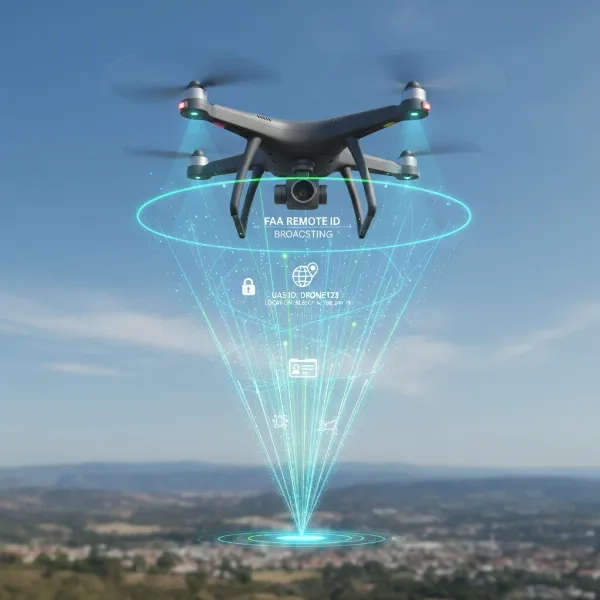 An illustrative image of a drone broadcasting a signal with identification and location data, overlaid with digital elements indicating Remote ID information.
The Evolution of Remote ID Rules: A Timeline to Strict Enforcement in 2026
The journey to full Remote ID implementation has involved several key milestones and deadlines. The FAA initially required drone manufacturers to comply with the rule by September 16, 2022, ensuring new drones would be equipped with the necessary technology. For drone operators, the initial operational compliance date was set for September 16, 2023. However, recognizing challenges in manufacturers’ ability to supply compliant equipment and operators’ readiness, the FAA granted a six-month extension.
This extension pushed the enforcement date to March 16, 2024. The FAA made it clear that this was the final extension, signaling a strict stance on compliance thereafter. As of 2026, these rules are fully in effect and rigorously enforced across the United States. This year marks a period where operators are expected to be fully compliant, with no further discretionary enforcement policies. Understanding this timeline is crucial, as operating a drone without proper Remote ID in 2026 carries significant penalties.
Who Must Comply with FAA Remote ID?
Remote ID requirements apply broadly to most drones operating in U.S. airspace. Generally, if your drone is required to be registered with the FAA, it must comply with Remote ID rules. This includes nearly all drones weighing over 0.55 pounds (250 grams), whether they are flown for recreational purposes, commercial operations under Part 107, or by public safety agencies.
- Commercial Drone Operators (Part 107): If you fly drones for business, you must register each individual drone and ensure it is Remote ID compliant. Each drone receives a unique registration number linked to its Remote ID serial number.
- Recreational Flyers: If your drone weighs 0.55 pounds or more, you must register it and comply with Remote ID. Recreational flyers can use one registration number for multiple drones in their inventory, listing the Remote ID serial numbers for each.
There are a few key exemptions. Drones weighing less than 0.55 pounds are generally exempt from registration and, consequently, from Remote ID. Additionally, drones operated within an FAA-Recognized Identification Area (FRIA) are not required to broadcast Remote ID. Currently, only educational institutions and FAA-recognized Community-Based Organizations can apply for FRIA status.
Navigating Remote ID Compliance: Standard vs. Module
For drone operators, there are primarily two pathways to achieve Remote ID compliance: using a Standard Remote ID drone or equipping your drone with a Remote ID Broadcast Module. Both methods fulfill the regulatory requirement, but they differ in how the information is broadcast.
Standard Remote ID Drones
|
Our Picks for the Best Drone in 2026
As an Amazon Associate I earn from qualifying purchases.
|
||
| Num | Product | Action |
|---|---|---|
| 1 | Drone with 1080P Camera - Foldable Remote Control Quadcopter with Gesture Control, 3D Flip, One Key Start, Emergency Stop, 2 Batteries, Easier to use, Toy for Kids Adult Beginners |

|
| 2 | GPS Drones with Camera for Adults 4K, FPV Drone Under 249g with Brushless Motor, GPS Auto Return, Follow Me, Circle Fly, Waypoint Flight, Foldable Drone with Gesture Control, 46Mins with 2 Batteries |
|
| 3 | Drone with Camera, Drones for Adults and Beginners, 1080P HD FPV Foldable Mini Drones for Kids, with 2 Batteries, Carrying Case, Trajectory Flight, Gravity Control, One-Key Takeoff/Landing, 360° Flip, Toys for Gift |
|
| 4 | DJI Mini 4K Camera Drone Combo, Drone with 4K UHD Camera for Adults, Under 249 g, 3-Axis Gimbal Stabilization, 10km Video Transmission, Auto Return, 2 Batteries for 62-Min Max Flight Time, QuickShots |
|
| 5 | DJI Mini 3 Fly More Combo (DJI RC), Drones with Camera for Adults 4K, 3 Batteries for 114-min Flight Time, Vertical Shooting, 32800ft (10km) Video Transmission, Lightweight Mini Drone for Beginners |
|
| 6 | Drone with Camera 1080P HD FPV Foldable Mini Drone for Beginners Kids Adults, Drone with One Key Take Off/Landing, Gesture Selfie, Altitude Hold, 3D Flip, Easy to Fly, 2 Batteries, Toys for Boys Girls |
|
| 7 | DJI Air 3S Fly More Combo (RC 2 Screen Remote Controller), Drone with 1" CMOS Wide-Angle & Medium Tele Camera for Adults, 4K/60fps, Omnidirectional Sensing & 3 Batteries for Extended Flight Time |
|
| 8 | Drone with Camera - Drone with Screen on Controller for Beginners, Foldable Remote Control Quadcopter with Gesture Control, 3D Flip, One Key Start, Emergency Stop, 2 Batteries, Easier to use to use |
|
| 9 | DJI Mini 4K, Drone with 4K UHD Camera for Adults, Under 249 g, 3-Axis Gimbal Stabilization, 10km Video Transmission, Auto Return, Wind Resistance, 1 Battery for 31-Min Max Flight Time, Intelligent |
|
| 10 | Drone with Camera for Adults 4K, Brushless Motor Drones for Kids Beginners, 60 Mins Flight, 130° Lens, FPV Foldable RC Quadcopter, Gesture Photography, Toys Gifts for Teen Boys Girls, Black |
|
A Standard Remote ID drone has the necessary broadcast capabilities built directly into its design, often integrated through firmware updates. Many newer drone models from leading manufacturers like DJI, Parrot, and Autel Robotics come with this feature. To ensure your Standard Remote ID drone is compliant, it’s essential to keep its firmware updated and verify its status on the FAA UAS Declaration of Compliance website. These drones broadcast their location, altitude, speed, and crucially, the real-time location and altitude of their control station (the operator).
Remote ID Broadcast Modules
For drones that do not have built-in Remote ID capabilities, a Broadcast Module provides a compliant solution. This is an external device that can be attached to your existing drone. These modules function similarly to Standard Remote ID, broadcasting the drone’s location, altitude, and speed. However, instead of the control station’s real-time location, a Broadcast Module transmits the takeoff location of the drone. When selecting a module, ensure it is FAA-approved by checking the FAA UAS Declaration of Compliance list. Companies like Dronetag offer such modules, allowing operators of older or non-compliant drones to meet the requirements without purchasing new equipment.
Steps to Ensure Your Drone is Remote ID Compliant
Achieving and maintaining Remote ID compliance in 2026 is a straightforward process, but it requires diligence. Following these steps will help ensure you operate within FAA regulations:
- Purchase Compliant Drones: If you are buying a new drone, prioritize models explicitly advertised as “Standard Remote ID Compliant.” Check the manufacturer’s specifications and the FAA’s Declaration of Compliance list to confirm.
- Equip with an FAA-Accepted Broadcast Module: If your current drone lacks built-in Remote ID, you must attach an FAA-accepted broadcast module. These lightweight devices are readily available from various manufacturers. Make sure the specific module you choose is listed on the FAA UAS Declaration of Compliance website.
- Register Your Drone and its Remote ID Serial Number: All drones over 0.55 lbs must be registered with the FAA via the FAA DroneZone. During registration, you will need to provide the Remote ID serial number. For Standard Remote ID drones, this is typically found within the drone’s settings or on its body. For modules, it’s on the device itself.
- Recreational flyers can list multiple drones under one registration, associating the Remote ID serial number for each.
- Part 107 commercial pilots must register each drone individually, each with a unique FAA registration number linked to its Remote ID.
- Verify Compliance on the FAA DOC Website: Before flying, always confirm your drone or module is listed on the FAA UAS Declaration of Compliance website. Filter by “RID” and “Accepted” to ensure your equipment meets the current standards.
- Stay Informed and Practice Safe Operation: Regularly check for FAA updates, especially regarding firmware for Standard Remote ID drones. Always operate your drone responsibly, adhere to airspace restrictions, and ensure your Remote ID system is active before takeoff.
Challenges and Benefits of Remote ID for Drone Operators
The implementation of Remote ID, like any significant regulation, comes with both advantages and challenges for the drone community. Understanding these aspects provides a balanced perspective on its role in the evolving drone landscape.
Benefits of Remote ID
- Enhanced Airspace Safety: Remote ID provides crucial real-time information to air traffic control, law enforcement, and other authorized personnel, improving situational awareness and reducing collision risks.
- Improved Public Trust and Acceptance: By allowing drones to be identified, Remote ID helps address public concerns about privacy and security, fostering greater acceptance of drone operations.
- Foundation for Advanced Operations: This “digital license plate” is a critical enabler for future drone capabilities such as beyond visual line of sight (BVLOS) flights, drone delivery services, and complex urban air mobility operations.
- Accountability and Enforcement: It empowers authorities to quickly identify and address drones operating unsafely or in restricted areas, ensuring accountability for all operators.
Challenges of Remote ID
- Cost Implications: For some operators, achieving compliance might involve purchasing a new, compliant drone or investing in an external broadcast module, representing an additional expense.
- Technical Complexity: While generally straightforward, understanding the nuances of serial numbers, firmware updates, and registration processes can be a learning curve for new or less tech-savvy operators.
- Privacy Concerns: While beneficial for safety, the broadcasting of drone and, in some cases, operator location raises privacy questions for some users, particularly recreational flyers. The distinction between broadcasting control station location (Standard RID) and takeoff location (Broadcast Module) offers a slight difference here.
- Operational Readiness: Ensuring all equipment is updated and correctly registered requires proactive management, which can be challenging for large fleets or individual hobbyists with multiple drones.
“Remote ID is not just another rule; it’s a foundational step towards integrating drones safely into our everyday lives. It balances innovation with accountability, paving the way for a more advanced and secure drone ecosystem.” – John Smith, Aerospace Regulatory Analyst
The Broader Impact of Remote ID on the Drone Industry
Remote ID’s full enforcement in 2026 has a ripple effect across the entire drone industry, influencing manufacturers, commercial service providers, and recreational flyers alike.
For manufacturers, Remote ID has necessitated significant design and engineering considerations. They must ensure new drones are built with Standard Remote ID capabilities and support existing models with firmware updates. This push towards integrated solutions sets a new industry standard.
Commercial drone service providers face heightened operational planning and compliance costs. Adhering to Remote ID is non-negotiable for Part 107 pilots, impacting everything from pre-flight checklists to fleet management. However, this compliance also enhances their legitimacy and ability to secure contracts, especially in sensitive areas or for advanced operations.
Hobbyists must adapt by either upgrading their equipment or purchasing broadcast modules for older drones. While some perceive it as an added burden, it’s an essential step for preserving the privilege of flight and ensuring the safety of shared airspace. Ultimately, Remote ID is a necessary evolution, pushing the entire industry towards greater maturity, safety, and operational integration. It fosters an environment where innovation can thrive within a structured and secure framework.
Expert Insights and the Future Outlook on Drone Regulations
As we look ahead, the full enforcement of FAA Remote ID in 2026 is unlikely to be the final chapter in drone regulation, but rather a significant milestone. The FAA continues to work towards integrating drones seamlessly into the national airspace, and Remote ID is a crucial piece of this puzzle. Industry experts anticipate that the data gathered through Remote ID will inform future regulatory decisions, potentially leading to more sophisticated airspace management systems and expanded operational allowances for drones.
The goal is to enable complex operations such as routine package delivery and autonomous flights over populated areas, which require a robust identification and tracking framework. We may see further refinements to Remote ID technology, potential international harmonization efforts, and an emphasis on real-time data integration with air traffic control systems. Remaining informed about these evolving regulations is paramount for anyone involved in the drone ecosystem.
Conclusion
The FAA’s Remote ID rules, now fully enforced in 2026, represent a pivotal moment for drone operations. By acting as a digital identification system, Remote ID significantly enhances airspace safety, improves accountability, and builds public confidence in drone technology. Whether you operate a drone for commercial gain or recreational enjoyment, understanding and adhering to these regulations is not just a legal obligation but a commitment to the responsible and sustainable growth of the drone industry. Ensuring your drone is compliant, registered, and properly broadcasting its identification is essential for avoiding penalties and contributing to a safer, more integrated airspace for all. Are you ready to embrace the future of drone flight?
Frequently Asked Questions
What if my drone doesn’t have Remote ID?
If your drone weighs over 0.55 lbs and lacks built-in Remote ID, you must equip it with an FAA-accepted Remote ID Broadcast Module. This external device attaches to your drone and broadcasts the necessary identification and location data, allowing you to comply with FAA regulations.
Can I fly without Remote ID in 2026?
No, as of March 16, 2024, flying a drone over 0.55 lbs without Remote ID (unless within a FRIA) can result in significant fines up to $27,500 and potential suspension or revocation of your pilot certificate. The FAA’s discretionary enforcement period has ended, making compliance mandatory.
Is there a drone Remote ID app?
While there isn’t one official FAA “Remote ID app” for pilots to broadcast data (as it’s handled by the drone or module), there are third-party apps and devices capable of receiving and displaying Remote ID broadcasts, used by authorities and even hobbyists to monitor drone activity.
How do I get a Remote ID module?
Remote ID broadcast modules can be purchased from various drone accessory retailers and manufacturers like Dronetag. Before purchasing, always confirm that the specific module you choose is listed as FAA-accepted on the FAA UAS Declaration of Compliance website to ensure it meets regulatory standards.
What is a FRIA?
A FRIA (FAA-Recognized Identification Area) is a designated airspace where drones without Remote ID broadcast capabilities can operate. Currently, only educational institutions and FAA-recognized Community-Based Organizations can apply for FRIA status. Flying within an approved FRIA is an exception to the Remote ID broadcast requirement.