Stepping into the pilot’s seat of a First-Person View (FPV) drone is an experience unlike any other, offering a thrilling perspective that traditional flying simply can’t match. For enthusiasts and professionals alike, the quality of your FPV goggles is paramount to unlocking this immersive world. DJI, a pioneer in drone technology, consistently pushes boundaries, and with the release of the DJI Goggles 3, they aim to redefine what pilots can expect from their visual interface. But do these latest goggles truly deliver an unparalleled experience, or are they simply an incremental upgrade? Let’s dive deep into the DJI Goggles 3 to uncover its innovations, compare it to its predecessors, and help you decide if this is the right flight companion for your aerial adventures.
What Are DJI Goggles 3? An Overview of DJI’s Latest FPV Tech
The DJI Goggles 3 represent the pinnacle of DJI’s FPV eyewear technology, designed to integrate seamlessly with their latest drone platforms like the Avata 2, Air 3, and Mini 4 Pro. More than just a viewing screen, these goggles act as your window into the drone’s world, translating its movements into a fluid, real-time visual feed. They are engineered to provide an immersive, low-latency, and high-definition experience, crucial for both precise FPV maneuvers and capturing stunning aerial footage. Positioning itself as a comprehensive solution, the Goggles 3 aims to set a new standard for first-person drone piloting.
Key Features & Specifications Driving the Immersive Flight
The power of the DJI Goggles 3 lies in its meticulously crafted features and robust specifications. Each element is designed to enhance your flight, from the clarity of the display to the reliability of the transmission system and the comfort of long-duration wear.
Crystal-Clear Vision: Display Technology
|
Our Picks for the Best Drone in 2026
As an Amazon Associate I earn from qualifying purchases.
|
||
| Num | Product | Action |
|---|---|---|
| 1 | Drone with Camera - Drone with Screen on Controller for Beginners, Foldable Remote Control Quadcopter with Gesture Control, 3D Flip, One Key Start, Emergency Stop, 2 Batteries, Easier to use to use |

|
| 2 | Drone with Camera for Adults 4K, Brushless Motor Drones for Kids Beginners, 60 Mins Flight, 130° Lens, FPV Foldable RC Quadcopter, Gesture Photography, Toys Gifts for Teen Boys Girls, Black |
|
| 3 | Drone with Camera 1080P HD FPV Foldable Mini Drone for Beginners Kids Adults, Drone with One Key Take Off/Landing, Gesture Selfie, Altitude Hold, 3D Flip, Easy to Fly, 2 Batteries, Toys for Boys Girls |
|
| 4 | DJI Mini 3 Fly More Combo (DJI RC), Drones with Camera for Adults 4K, 3 Batteries for 114-min Flight Time, Vertical Shooting, 32800ft (10km) Video Transmission, Lightweight Mini Drone for Beginners |
|
| 5 | GPS Drones with Camera for Adults 4K, FPV Drone Under 249g with Brushless Motor, GPS Auto Return, Follow Me, Circle Fly, Waypoint Flight, Foldable Drone with Gesture Control, 46Mins with 2 Batteries |
|
| 6 | DJI Air 3S Fly More Combo (RC 2 Screen Remote Controller), Drone with 1" CMOS Wide-Angle & Medium Tele Camera for Adults, 4K/60fps, Omnidirectional Sensing & 3 Batteries for Extended Flight Time |
|
| 7 | DJI Mini 4K Camera Drone Combo, Drone with 4K UHD Camera for Adults, Under 249 g, 3-Axis Gimbal Stabilization, 10km Video Transmission, Auto Return, 2 Batteries for 62-Min Max Flight Time, QuickShots |
|
| 8 | DJI Mini 4K, Drone with 4K UHD Camera for Adults, Under 249 g, 3-Axis Gimbal Stabilization, 10km Video Transmission, Auto Return, Wind Resistance, 1 Battery for 31-Min Max Flight Time, Intelligent |
|
| 9 | Drone with Camera, Drones for Adults and Beginners, 1080P HD FPV Foldable Mini Drones for Kids, with 2 Batteries, Carrying Case, Trajectory Flight, Gravity Control, One-Key Takeoff/Landing, 360° Flip, Toys for Gift |
|
| 10 | Drone with 1080P Camera - Foldable Remote Control Quadcopter with Gesture Control, 3D Flip, One Key Start, Emergency Stop, 2 Batteries, Easier to use, Toy for Kids Adult Beginners |
|
At the heart of the DJI Goggles 3 are dual 0.49-inch Micro-OLED screens, delivering a stunning 1920×1080 resolution for each eye. This high resolution, combined with a smooth 100Hz refresh rate, ensures that the visual feed from your drone is incredibly crisp, vibrant, and free from motion blur. For extended flying sessions, the goggles are TüV Rheinland certified for low blue light, making them gentler on your eyes.
The Field of View (FOV) on the Goggles 3 is a comfortable 44°, a conscious design choice by DJI. While some earlier models featured a wider FOV, many pilots found it led to blurry edges, requiring them to scale down the display. This optimized 44° FOV offers a perfectly balanced and sharper visual experience. Furthermore, the goggles cater to a wide range of vision needs with a diopter adjustment from -6.0 D to +2.0 D, and even include -2.0 diopter lenses to extend the lower range to -8.0 D, ensuring clarity for nearly all users. The interpupillary distance (IPD) can also be adjusted between 56mm and 72mm for a personalized fit and optimal viewing.
Unrivaled Connection: O4 Video Transmission
The DJI Goggles 3 are equipped with the cutting-edge OcuSync 4.0 (O4) video transmission system, a significant leap forward in signal reliability and performance. This advanced system boasts an ultra-low latency of just 24ms when transmitting 1080p video at 100fps, minimizing delay between your controls and the drone’s response. With a maximum video bitrate of 60Mbps, you receive a high-quality, stable image even in challenging environments.
The O4 system extends the maximum transmission range up to an impressive 13km (FCC), providing greater freedom and flexibility for long-distance flights. Initially launched with compatibility for the DJI Avata 2, the Goggles 3 have since received firmware updates to support O3 Air Units, broadening their usability across a wider array of DJI drones, including the Air 3 and Mini 4 Pro. This ensures that users with existing DJI digital systems can integrate the Goggles 3 into their setup.
Comfort and Intuitive Control: Design & Usability
Comfort during FPV flights is paramount, especially for longer sessions. The DJI Goggles 3 address this with an innovative forehead pad design that significantly reduces pressure on the eyes and nose, enhancing overall comfort. The integrated battery pack, located at the back of the head strap, contributes to a balanced weight distribution, eliminating the need for dangling external battery cables. This built-in 21.6Wh battery provides approximately three hours of operating time, with a quick recharge time of about 1 to 1.5 hours via USB-C. For extended use, the Goggles 3 can also be powered by an external USB power bank.
Navigating menus and settings is made intuitive with the return of a precise joystick controller, replacing the often-criticized touchpad of previous models. This tactile control offers a more responsive and enjoyable user experience. The goggles also feature foldable, non-removable antennas that streamline the design while still offering excellent signal reception. Practical additions like a one-tap defogging function for clear vision in varying temperatures and a proximity sensor that automatically turns off the screens when removed further enhance usability.
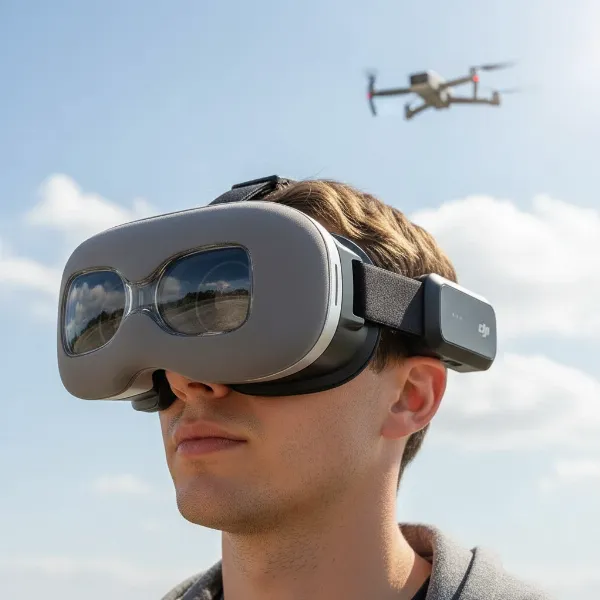 DJI Goggles 3 worn by a pilot, showcasing the forehead pad and integrated battery for superior comfort during flight.
Situational Awareness: Real View PiP
A standout safety and convenience feature in the DJI Goggles 3 is Real View Picture-in-Picture (PiP). Utilizing two front-facing cameras, this technology allows pilots to quickly glance at their surroundings without needing to remove the goggles. A simple double-tap on the right side of the goggles activates this mode, displaying a real-time, 720p feed of your environment either in a small window within your FPV view or as a full-screen overlay.
Real View PiP supports both 2D and 3D modes, offering an enhanced sense of depth when needed. While the image quality and field of view from the front cameras aren’t comparable to dedicated VR headsets, it provides invaluable situational awareness, enabling safer takeoffs, landings, and navigation in complex environments. This feature minimizes distractions and enhances the overall safety of your FPV experience.
DJI Goggles 3 vs. Predecessors: An Upgrade Worth Making?
For pilots already invested in DJI’s FPV ecosystem, the question of upgrading is always at the forefront. Let’s compare the DJI Goggles 3 to its earlier iterations to see where it truly shines and whether it justifies the investment.
Goggles 2 Comparison
The DJI Goggles 2 were a popular choice, but the Goggles 3 bring several significant improvements. The most immediate difference is comfort and fitment, with the Goggles 3’s forehead pad and integrated battery design alleviating pressure points and offering a more balanced feel. While the Goggles 2 sported a wider 51° FOV, many users experienced blurry edges, a problem resolved by the Goggles 3’s refined 44° FOV which delivers a crisper, more consistent image. The O4 transmission system in the Goggles 3 offers lower latency, higher bitrate, and extended range compared to the Goggles 2’s O3. Although the Goggles 2 had initial broader compatibility, the Goggles 3 is rapidly catching up with O3 Air Unit support via firmware, and its O4 system makes it more future-proof for upcoming DJI drones. The switch from a touchpad to a physical joystick on the Goggles 3 is also a welcome change for more intuitive menu navigation.
Goggles Integra & N3 Differences
The DJI Goggles Integra shared a similar integrated battery and forehead pad comfort design with the Goggles 3, and also featured a 44° FOV. However, the Goggles 3 surpasses the Integra with the newer O4 transmission system, offering superior performance. The Goggles N3, on the other hand, is positioned as a more budget-friendly option. It’s a bulkier, box-style goggle with a single screen and lacks IPD and focus adjustments (though it can accommodate glasses). While offering decent performance for casual pilots, the Goggles 3 provides a premium, high-performance experience that the N3 cannot match in terms of display clarity, feature set, and advanced transmission.
The FPV Goggles V2 Legacy
The original DJI FPV Goggles V2 hold a special place for many, particularly for their compatibility with older DJI FPV systems and the ability to fly analog FPV rigs (with adapters). However, the Goggles 3 represents a significant generational leap. The V2 goggles are limited in their digital capabilities, for example, they cannot record On-Screen Display (OSD) data directly in recordings with O3 or O4 Air Units. The Goggles 3, with its Micro-OLED screens, O4 transmission, enhanced comfort, and advanced features like Real View PiP, offers a far superior and more modern digital FPV experience, making it the clear choice for anyone focused on current and future DJI digital systems.
Pros and Cons of the DJI Goggles 3
Like any advanced piece of technology, the DJI Goggles 3 comes with its own set of strengths and weaknesses. Understanding these can help you weigh your options effectively.
Advantages:
- Superior Comfort: The innovative forehead pad and integrated battery design significantly reduce pressure and improve wearability for extended flights.
- Enhanced Visual Clarity: Dual 1080p Micro-OLED screens with a 100Hz refresh rate and an optimized 44° FOV deliver a crisp, immersive, and blur-free viewing experience.
- Cutting-Edge Transmission: OcuSync 4.0 (O4) provides ultra-low latency (24ms), a high bitrate (60Mbps), and an impressive 13km range for reliable and stable video feeds.
- Increased Safety and Awareness: Real View PiP (Picture-in-Picture) allows pilots to see their surroundings without removing the goggles, enhancing safety during takeoffs, landings, and general situational awareness.
- Intuitive Control: The physical joystick replaces the touchpad, offering more precise and tactile menu navigation.
- Future-Proofing: Compatibility with O4 Air Units and recent firmware updates for O3 Air Units ensure the Goggles 3 remain relevant for DJI’s evolving drone ecosystem.
- Convenient Features: Integrated battery with approximately 3 hours of runtime, one-tap defogging, and a proximity sensor add to the overall user convenience.
Disadvantages:
- Premium Price Point: The DJI Goggles 3 come with a higher price tag compared to previous models and some third-party alternatives.
- Non-Removable Antennas: The integrated antenna design, while sleek, limits the ability to upgrade to aftermarket antennas for potentially improved range or signal customization.
- Real View PiP Quality: While useful for safety, the 720p image quality and narrow FOV of the front cameras are not on par with dedicated VR headsets, making it less immersive than some might hope.
- Limited Older System Compatibility: While now supporting O3, they do not support the oldest DJI FPV systems (like original FPV Air Units) or analog FPV, which might be a drawback for pilots with diverse legacy equipment.
- Activation Sensitivity: Some users have reported that the double-tap gesture for Real View PiP can sometimes require a firm tap to register.
Who Should Buy the DJI Goggles 3?
The DJI Goggles 3 are a premium product designed for specific types of pilots and applications.
- Existing DJI Drone Pilots: If you own an Avata 2, Air 3, Mini 4 Pro, or any drone using the O3 Air Unit and are looking for the absolute best FPV experience, the Goggles 3 are a compelling upgrade. The O4 transmission system and enhanced features integrate seamlessly with these platforms.
- New FPV Enthusiasts: For those just entering the world of digital FPV and seeking a top-tier experience from the outset, the Goggles 3 offer a robust, high-performance, and user-friendly entry point, particularly if paired with a compatible DJI drone.
- Professional Aerial Cinematographers: The unparalleled clarity, low latency, and stable transmission of the Goggles 3 make them ideal for precise drone control, which is essential for capturing cinematic footage from challenging perspectives.
- Pilots Prioritizing Comfort and Features: If long flight sessions are common for you, or if safety features like Real View PiP and intuitive controls are high on your priority list, the Goggles 3’s ergonomic design and advanced functionalities will be a significant advantage.
- Those Seeking Future-Proofing: Investing in the O4 system means you’re equipped with DJI’s latest transmission technology, likely ensuring compatibility and optimal performance with their next-generation drones.
Conversely, if you primarily fly older DJI FPV systems (like those requiring V2 goggles for analog support) or are on a strict budget, the higher cost and lack of legacy analog support might make older models or a budget-friendly alternative more suitable.
Conclusion
The DJI Goggles 3 undeniably represent a significant step forward in immersive FPV flight. With their stunning Micro-OLED displays, game-changing OcuSync 4.0 transmission, and a focus on pilot comfort and safety through features like Real View PiP, DJI has crafted a formidable piece of hardware. While the premium price and lack of legacy analog support might deter some, the enhanced visual clarity, ultra-low latency, and intelligent design make them a top contender for anyone seeking the ultimate digital FPV experience. For those ready to embrace the future of drone piloting, the DJI Goggles 3 offer an unparalleled window into the skies.
Are you ready to truly see the world from your drone’s perspective?
Frequently Asked Questions
Are DJI Goggles 3 compatible with older DJI FPV drones?
The DJI Goggles 3 are primarily designed for O4 compatible drones like the Avata 2, Air 3, and Mini 4 Pro. However, a recent firmware update has extended compatibility to drones utilizing the O3 Air Unit, broadening their use. They do not support older DJI FPV systems or analog FPV.
Can I wear glasses with DJI Goggles 3?
No, you cannot wear prescription glasses comfortably with the DJI Goggles 3. However, the goggles feature a built-in diopter adjustment ranging from -6.0 D to +2.0 D, and include additional -2.0 diopter lenses to extend the range to -8.0 D, catering to various vision needs without external eyewear.
What is Real View PiP on DJI Goggles 3?
Real View PiP (Picture-in-Picture) is a safety feature that uses two front-facing cameras on the Goggles 3 to provide a real-time view of your immediate surroundings. This allows pilots to observe their physical environment without removing the goggles, enhancing situational awareness during critical moments like takeoff and landing.
How long does the DJI Goggles 3 battery last?
The DJI Goggles 3 feature an integrated battery pack that provides approximately three hours of operating time on a full charge. This battery is built into the head strap, offering improved comfort and weight distribution compared to external battery designs.
What is the main difference between DJI Goggles 3 and Goggles 2?
The primary differences between the DJI Goggles 3 and Goggles 2 lie in comfort, transmission system, and FOV. The Goggles 3 offer superior comfort with a forehead pad and integrated battery, feature the newer OcuSync 4.0 (O4) transmission for better performance, and have an optimized 44° FOV for crisper visuals compared to the Goggles 2’s 51° FOV which often had blurry edges.