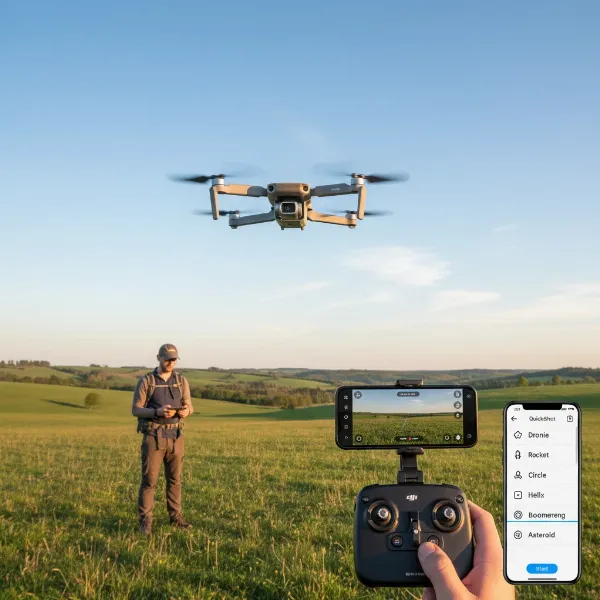
Capturing smooth, cinematic footage is paramount in today’s visual world, whether you’re a drone pilot soaring through the skies or a content creator vlogging on the go. The bane of any videographer’s existence is shaky, unprofessional-looking video. Fortunately, two primary technologies have emerged to combat this: 3-Axis Gimbals and Electronic Image Stabilization (EIS). Understanding their fundamental differences and unique strengths is crucial for making informed decisions about your gear and elevating your creative output.
Unveiling Stabilization Technologies: 3-Axis Gimbals and EIS
The quest for stable imagery has driven innovation for centuries, from ancient nautical instruments to cutting-edge digital algorithms. Modern stabilization methods aim to counteract unwanted movement, ensuring your camera captures crisp, steady visuals, no matter how dynamic the environment.
What is a 3-Axis Gimbal? Understanding Mechanical Stabilization
A 3-axis gimbal is a sophisticated mechanical stabilization system designed to keep a camera perfectly level and oriented despite external movements. It utilizes a series of brushless motors and advanced sensors, including an Inertial Measurement Unit (IMU), to detect and instantly counteract unwanted motion across three axes:
- Pitch (Tilt): Controls the camera’s up and down movement.
- Roll (Horizon Level): Keeps the horizon perfectly level, preventing tilted shots.
- Yaw (Pan): Manages the camera’s left and right rotation.
|
Our Picks for the Best Drone in 2026
As an Amazon Associate I earn from qualifying purchases.
|
||
| Num | Product | Action |
|---|---|---|
| 1 | GPS Drones with Camera for Adults 4K, FPV Drone Under 249g with Brushless Motor, GPS Auto Return, Follow Me, Circle Fly, Waypoint Flight, Foldable Drone with Gesture Control, 46Mins with 2 Batteries |

|
| 2 | DJI Air 3S Fly More Combo (RC 2 Screen Remote Controller), Drone with 1" CMOS Wide-Angle & Medium Tele Camera for Adults, 4K/60fps, Omnidirectional Sensing & 3 Batteries for Extended Flight Time |
|
| 3 | Drone with Camera for Adults 4K, Brushless Motor Drones for Kids Beginners, 60 Mins Flight, 130° Lens, FPV Foldable RC Quadcopter, Gesture Photography, Toys Gifts for Teen Boys Girls, Black |
|
| 4 | Drone with Camera - Drone with Screen on Controller for Beginners, Foldable Remote Control Quadcopter with Gesture Control, 3D Flip, One Key Start, Emergency Stop, 2 Batteries, Easier to use to use |
|
| 5 | DJI Mini 3 Fly More Combo (DJI RC), Drones with Camera for Adults 4K, 3 Batteries for 114-min Flight Time, Vertical Shooting, 32800ft (10km) Video Transmission, Lightweight Mini Drone for Beginners |
|
| 6 | Drone with Camera, Drones for Adults and Beginners, 1080P HD FPV Foldable Mini Drones for Kids, with 2 Batteries, Carrying Case, Trajectory Flight, Gravity Control, One-Key Takeoff/Landing, 360° Flip, Toys for Gift |
|
| 7 | DJI Mini 4K, Drone with 4K UHD Camera for Adults, Under 249 g, 3-Axis Gimbal Stabilization, 10km Video Transmission, Auto Return, Wind Resistance, 1 Battery for 31-Min Max Flight Time, Intelligent |
|
| 8 | DJI Mini 4K Camera Drone Combo, Drone with 4K UHD Camera for Adults, Under 249 g, 3-Axis Gimbal Stabilization, 10km Video Transmission, Auto Return, 2 Batteries for 62-Min Max Flight Time, QuickShots |
|
| 9 | Drone with Camera 1080P HD FPV Foldable Mini Drone for Beginners Kids Adults, Drone with One Key Take Off/Landing, Gesture Selfie, Altitude Hold, 3D Flip, Easy to Fly, 2 Batteries, Toys for Boys Girls |
|
| 10 | Drone with 1080P Camera - Foldable Remote Control Quadcopter with Gesture Control, 3D Flip, One Key Start, Emergency Stop, 2 Batteries, Easier to use, Toy for Kids Adult Beginners |
|
These motors work in real-time, making thousands of micro-adjustments per second to isolate the camera from the platform it’s mounted on, such as a drone or a handheld rig. The camera effectively “floats” independently, resulting in incredibly fluid and professional-looking footage.
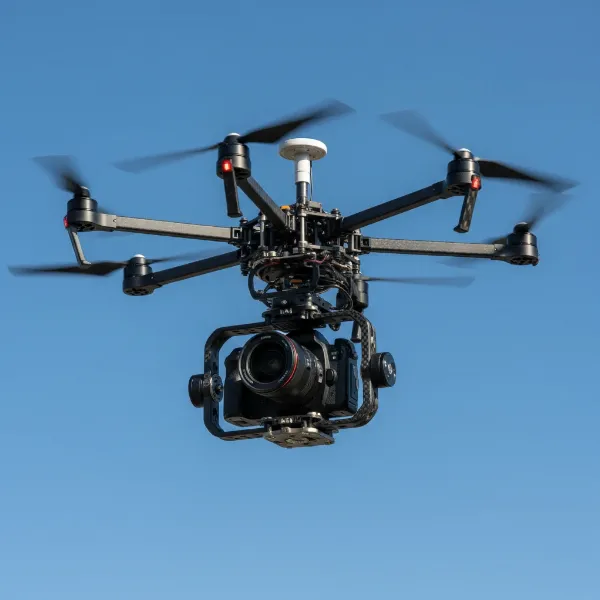 A 3-axis gimbal on a drone mechanically stabilizing a high-quality camera during flight
What is Electronic Image Stabilization (EIS)? The Power of Software
Electronic Image Stabilization (EIS) offers a different approach, relying on software algorithms rather than physical mechanics. It’s a digital solution that processes video footage after it’s been captured by the sensor, either in real-time within the camera or during post-production.
EIS utilizes the camera’s internal motion sensors (like gyroscopes and accelerometers) to detect shakes and jitters. Once movement is identified, the software digitally crops the edges of the video frame and shifts the remaining image within that cropped area to counteract the detected motion. This creates the illusion of a steady shot by ensuring the main subject remains stable, even if the camera itself is moving. This technique is widely adopted in devices where space and cost are critical considerations, such as action cameras and smartphones.
The Evolution of Stability: A Brief History of Gimbals and EIS
The concept of a gimbal dates back to ancient China, used for practical applications like stable compasses and incense burners. It wasn’t until the advent of motorized systems in the 21st century that gimbals transformed modern videography. These motorized gimbals moved beyond simple pivot points, using precise electronics to actively stabilize cameras across multiple axes, revolutionizing handheld and aerial filmmaking.
Electronic Image Stabilization, on the other hand, is a more recent innovation, emerging with the rise of digital cameras and powerful processors. Early forms were basic, often introducing artifacts, but continuous advancements in software algorithms and processing power have made EIS remarkably effective, especially for casual users and specific action-oriented scenarios. The ongoing development of both technologies reflects a constant drive to achieve ever-smoother, more immersive visual experiences.
Advantages and Disadvantages: 3-Axis Gimbal
Three-axis gimbals are the workhorses of professional videography, renowned for their ability to deliver exceptional stability. However, their sophisticated mechanical nature comes with its own set of considerations.
Advantages of a 3-Axis Gimbal:
- Superior Stability: Gimbals offer unparalleled smoothness, effectively eliminating noticeable jitters and shakes even during significant camera movement. They provide a truly “floating” camera effect, essential for cinematic results.
- No Image Cropping: Unlike EIS, gimbals stabilize by physically repositioning the camera, meaning the original field of view and resolution of your footage are preserved entirely. There’s no loss of detail or image information.
- High Image Quality: By physically isolating the camera from motion, gimbals ensure consistently sharp and clear images, even in challenging lighting conditions or with longer exposure times.
- Robust Performance: They excel in situations with more aggressive movement, such as running, fast-panning shots, or when a drone encounters strong winds, maintaining a level horizon and smooth tracking.
- Precise Control: Many gimbals offer advanced controls, allowing operators to fine-tune camera movements, follow subjects with high accuracy, and achieve complex, dynamic shots that would be impossible manually.
Disadvantages of a 3-Axis Gimbal:
- Bulk and Weight: Gimbals are mechanical devices with motors and frames, making them significantly larger and heavier than camera-only setups. This impacts portability and can be physically demanding for extended use.
- Higher Cost: The intricate mechanical and electronic components make gimbals a more expensive investment compared to cameras relying solely on EIS.
- Setup and Balancing: Before use, a gimbal requires careful balancing to match the camera’s weight and center of gravity. This can be time-consuming, especially when changing lenses or accessories.
- Increased Power Consumption: The motors constantly drawing power to stabilize the camera can lead to shorter battery life for both the gimbal itself and, in the case of drones, the drone’s flight time.
- Learning Curve: While modern gimbals are user-friendly, mastering their full potential and achieving truly cinematic movements requires practice and a degree of skill.
Advantages and Disadvantages: Electronic Image Stabilization (EIS)
Electronic Image Stabilization represents a significant leap in accessibility, bringing smoother footage to a broader range of devices. Its software-based nature presents both compelling benefits and inherent limitations.
Advantages of Electronic Image Stabilization (EIS):
- Compact and Lightweight: Since EIS is software-based, it requires no bulky external hardware. This makes devices with EIS incredibly portable, fitting easily into pockets or small bags.
- Cost-Effective: Integrating EIS into a camera is generally more affordable than manufacturing and incorporating a mechanical gimbal, making stabilized footage accessible in budget-friendly devices.
- Lower Power Consumption: EIS primarily relies on processing power rather than physical motors, typically resulting in lower battery drain compared to mechanical gimbals.
- Instantaneous Operation: There’s no setup or balancing required; EIS is ready to go as soon as the camera is powered on, perfect for spontaneous shooting.
- Versatility: EIS can adapt to various movements and is particularly effective for minor shakes and vibrations, making it suitable for action cameras and vlogging.
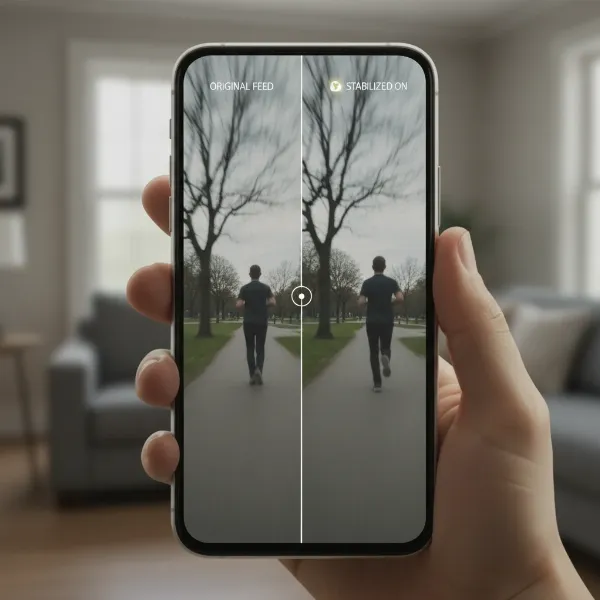 Smartphone screen showing a split-screen comparison of a shaky video and an electronically stabilized (cropped) version
Disadvantages of Electronic Image Stabilization (EIS):
- Image Cropping: To stabilize footage, EIS digitally zooms in and shifts the image, which inherently crops the frame. This results in a reduced field of view and can lead to a slight loss of resolution.
- Potential for Artifacts: In some cases, especially with aggressive movements or lower light, EIS can introduce artifacts like the “jello effect” (rolling shutter distortion), warping, or a somewhat artificial, “floating” look.
- Less Effective for Large Movements: While good for minor jitters, EIS struggles with large, abrupt camera movements. It can’t compensate for significant jostling as effectively as a mechanical gimbal.
- Dependent on Lighting: EIS can perform less effectively in low-light conditions, as the cropping and digital manipulation can exacerbate noise and reduce overall image quality.
- Not a Physical Isolation: Because it’s a digital correction, EIS doesn’t physically isolate the camera from vibrations, meaning some subtle micro-jitters might still be present, especially on drones in windy conditions.
Applications Across Industries: Where Gimbals and EIS Shine
Both 3-axis gimbals and EIS have found their niches, transforming how visuals are captured across various sectors. The choice often depends on the specific demands of the task at hand.
3-Axis Gimbals: The Choice for Professional Precision
Gimbals are the preferred tool for scenarios demanding the highest level of stability and image fidelity. Their mechanical precision makes them indispensable in:
- Professional Filmmaking: From Hollywood productions to independent films, gimbals are used for smooth tracking shots, dynamic camera movements, and capturing complex scenes without shake.
- High-End Drone Videography: Drones equipped with 3-axis gimbals deliver breathtaking aerial footage, maintaining a perfectly level horizon and stable image even during fast maneuvers or in challenging wind conditions.
- Journalism and Documentaries: For capturing events with a cinematic feel, gimbals allow camera operators to move with subjects while maintaining professional stability.
- Real Estate and Architecture: Showcasing properties with fluid walk-throughs and fly-throughs that convey a sense of space and luxury.
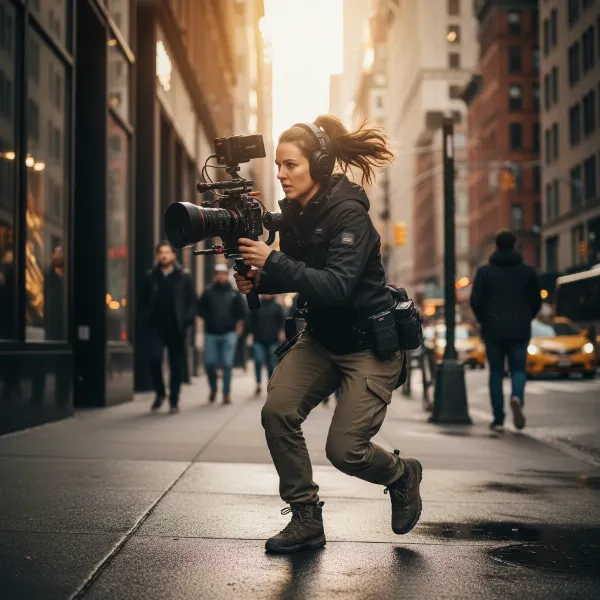 A professional videographer operating a handheld 3-axis gimbal with a mirrorless camera for cinematic footage
Electronic Image Stabilization (EIS): Agility and Accessibility
EIS excels in environments where portability, cost, and quick capture are priorities. It’s the go-to for:
- Action Cameras: Essential for capturing extreme sports and adventure footage, where the camera is subjected to constant, unpredictable motion. EIS keeps the frantic action watchable.
- Smartphones: Virtually all modern smartphones integrate EIS to enhance video calls, vlogging, and casual video recording, making everyday content creation smoother.
- Entry-Level Drones: Many consumer-grade drones use EIS to offer a degree of stabilization without the added cost and complexity of a mechanical gimbal, making them more affordable for hobbyists.
- Vlogging and Live Streaming: For creators who need a lightweight, unencumbered setup, EIS provides enough stability for talking-head videos or dynamic walking shots.
Side-by-Side Comparison: 3-Axis Gimbal vs. EIS
To help you visualize the core differences, here’s a comparative breakdown of these two stabilization titans:
| Feature | 3-Axis Gimbal (Mechanical Stabilization) | Electronic Image Stabilization (EIS) |
|---|---|---|
| Mechanism | Physical motors and sensors adjust camera orientation. | Software algorithms digitally process and shift the image. |
| Axes of Action | Compensates for pitch, roll, and yaw (rotational movements). | Compensates for detected camera movement across multiple axes digitally. |
| Image Quality | Excellent; no cropping, full resolution, sharper details. | Good; involves cropping, potential resolution loss, can introduce artifacts. |
| Effectiveness | Superior for large, aggressive movements and in challenging conditions. | Good for minor shakes and jitters, struggles with extreme motion. |
| Cost | Higher, due to complex hardware. | Lower, as it’s primarily software-based. |
| Portability | Less portable; bulkier and heavier. | Highly portable; integrated into camera without added bulk. |
| Power Cons. | Higher (motors constantly active). | Lower (processing power used). |
| Setup | Requires balancing and calibration. | Instantaneous; no setup needed. |
| Best Use Cases | Professional filmmaking, high-end drone shots, cinematic productions. | Action cameras, smartphones, vlogging, casual use, budget-friendly drones. |
Choosing Your Stabilization: Selecting the Right Technology for Your Needs
Deciding between a 3-axis gimbal and EIS comes down to understanding your specific requirements, priorities, and creative aspirations. There’s no universal “better” option; only the best fit for your unique situation.
Determine Your Purpose
- For Cinematic Excellence: If your goal is to produce Hollywood-level, butter-smooth footage for professional projects, a 3-axis gimbal is indispensable. Its mechanical precision is unmatched for creating fluid, intentional camera movements.
- For Action and Adventure: For capturing dynamic, fast-paced activities where durability and a compact form factor are crucial, EIS, often found in action cameras, provides effective stabilization without inhibiting movement.
- For Casual Vlogging and Everyday Moments: If you’re primarily shooting with a smartphone or a compact camera for social media or personal memories, EIS offers sufficient stability to make your videos enjoyable and watchable.
- For Drone Pilots: Serious aerial videographers will almost always opt for a drone with a 3-axis gimbal to ensure the highest quality, most stable shots, especially when battling wind or performing complex flight paths.
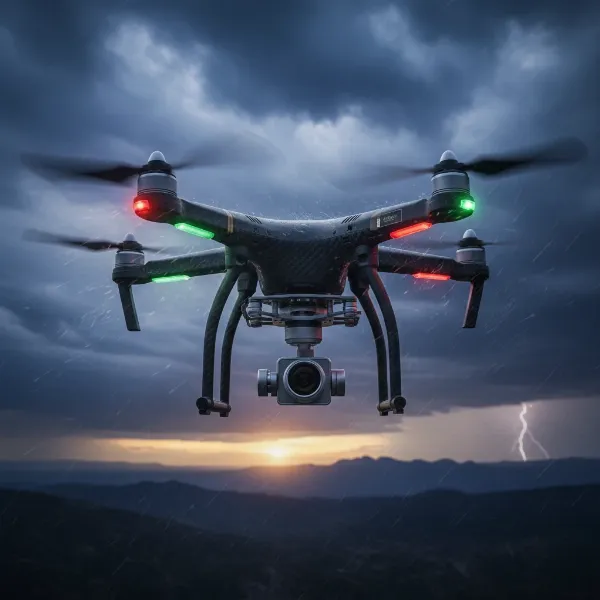 A drone with a 3-axis gimbal flying smoothly in a moderately windy environment, camera remaining stable
Consider Your Budget
Gimbals represent a more significant investment. If budget is a primary concern, a camera with advanced EIS can deliver surprisingly good results for a fraction of the cost. However, for those seeking top-tier quality, the investment in a gimbal is often justified.
Prioritize Portability and Ease of Use
If a lightweight, grab-and-go setup is paramount, EIS is the clear winner. Smartphones and action cameras with EIS are designed for maximum convenience. If you don’t mind the extra gear and a few minutes of setup for superior stability, a gimbal is a worthwhile trade-off.
Desired Image Quality
The golden rule is that physical stabilization generally outperforms digital in terms of raw image quality. If preserving every pixel, avoiding cropping, and minimizing artifacts are your top priorities, a 3-axis gimbal is the way to go. EIS, while impressive, will always involve some compromise in these areas.
> “The choice between a gimbal and EIS isn’t about one being inherently ‘superior,’ but rather about aligning the technology with the specific demands of your creative vision and practical workflow.” – Dr. Elena Petrova, Lead Imaging Scientist at Quantum Optics Lab
Hybrid Solutions: Combining the Best of Both Worlds
It’s also worth noting that some advanced camera systems and drones now integrate both mechanical and electronic stabilization, leveraging the strengths of each. For example, a drone might have a 3-axis gimbal for primary physical stability, with EIS subtly augmenting the footage for ultra-smooth results, or to correct minor residual jitters. This hybrid approach aims to provide the best possible stabilization, pushing the boundaries of what’s achievable in dynamic shooting environments.
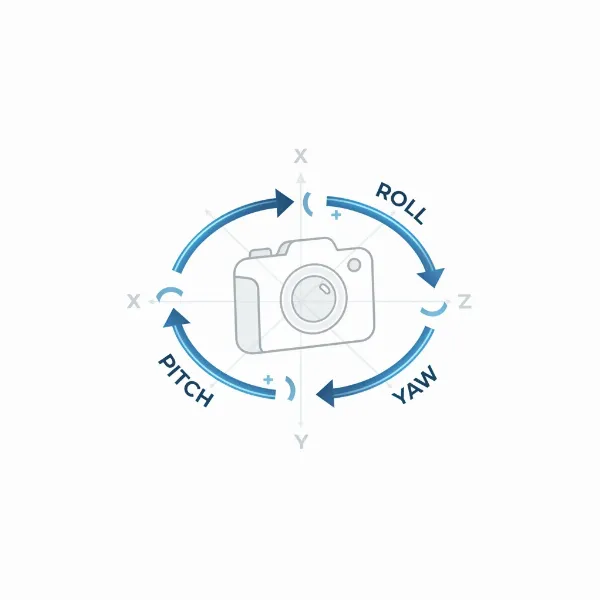 A clear diagram illustrating the three axes of stabilization: pitch, roll, and yaw for a camera
Conclusion
The journey to perfectly stable footage is an exciting one, paved by both ingenious mechanical designs and sophisticated digital advancements. Whether you opt for the robust, uncompromising stability of a 3-axis gimbal or the agile, cost-effective convenience of Electronic Image Stabilization, both technologies play a vital role in enabling creators to capture stunning visuals. Your ultimate decision should reflect a careful balance of your project’s demands, budget, and desired level of production quality. As technology continues to evolve, we can expect even more innovative solutions that push the boundaries of smooth, immersive videography. What considerations are most important for your next stabilized shot?
Frequently Asked Questions
Is a 3-axis gimbal always better than EIS?
While a 3-axis gimbal generally offers superior mechanical stability, no image cropping, and higher fidelity, it’s not “always better.” EIS excels in portability, cost-effectiveness, and spontaneous shooting. The “better” option depends on your specific needs, budget, and the type of footage you aim to capture.
Can EIS achieve cinematic results?
Modern EIS has improved significantly and can achieve very smooth, professional-looking results for certain types of footage, especially in well-lit conditions and with controlled movements. However, for the most demanding cinematic shots, particularly those involving complex camera movements or challenging environments, a 3-axis gimbal still provides a level of organic fluidity and precise control that EIS struggles to match.
How does stabilization affect drone flight time?
A 3-axis gimbal adds weight to a drone, which requires more power for lift and maneuverability. This increased power consumption will typically reduce the drone’s overall flight time compared to a drone with a lighter EIS-only camera setup. Therefore, drone pilots using gimbals often carry extra batteries.
What is “rolling shutter” and how do gimbals/EIS address it?
Rolling shutter is an effect where fast-moving objects or camera shakes cause an image to appear skewed or wobbly (often called “jello effect”) because the camera sensor captures the image line by line rather than instantaneously. Gimbals minimize rolling shutter by physically reducing camera shake. EIS can sometimes exacerbate rolling shutter artifacts due to digital manipulation, but advanced EIS algorithms often include features to counteract this.
Are there other types of image stabilization?
Yes, beyond 3-axis gimbals (a form of mechanical/optical stabilization) and EIS, other stabilization methods include Optical Image Stabilization (OIS), where elements within the lens or sensor physically shift to correct for movement. Some high-end systems also boast “5-axis” or “6-axis” stabilization, which combines different techniques to compensate for a broader range of rotational and translational movements.