Embarking on a journey with your drone opens up a world of breathtaking aerial photography and unique perspectives. However, the excitement of travel can quickly turn to frustration if you’re not prepared for the specific regulations governing drone transportation, particularly concerning batteries. Navigating airport security and airline policies can seem daunting, but understanding the rules set by authorities like the Transportation Security Administration (TSA) and individual airlines is essential for a smooth journey. This comprehensive guide will equip you with the knowledge needed to travel confidently with your drone, ensuring both your equipment and your trip remain safe and compliant.
Understanding Drone Travel Basics: Carry-On vs. Checked Baggage
When traveling with a drone, one of the first decisions you’ll face is whether to pack it in your carry-on or checked luggage. While the TSA generally permits drones in both, there are critical distinctions and strong recommendations that favor carry-on for the drone itself. Most experts advise keeping your drone with you in the cabin to protect it from potential damage that checked baggage often endures. Fragile components like gimbals, cameras, and propellers are safer under your direct supervision, away from the rough handling of luggage systems.
However, the strictest rules apply not to the drone’s body, but to its power source: lithium-ion batteries. These batteries pose a fire risk in cargo holds, making them subject to rigorous federal and international regulations. Understanding these rules is paramount, as they often dictate where your drone components must be placed. While the drone body might be acceptable in checked luggage, any detached lithium-ion batteries must always accompany you in the cabin.
Navigating Lithium-ion Battery Regulations: TSA and FAA Guidelines
The golden rule for drone travel revolves around its lithium-ion batteries: they must always be packed in your carry-on baggage. This regulation is universal across airlines and is mandated by safety agencies like the TSA and the Federal Aviation Administration (FAA) due to the fire risk associated with these batteries in cargo compartments. Ignoring this rule can lead to significant delays, confiscation of your batteries, or even being denied boarding.
Lithium-ion batteries are categorized primarily by their Watt-hour (Wh) rating, which determines how many you can carry and under what conditions. Calculating the Wh is straightforward: simply multiply the voltage (V) by the amp-hours (Ah) or divide milliamp-hours (mAh) by 1,000 and then multiply by voltage.
- Batteries Under 100 Wh: Most consumer drones, like many in the DJI Mavic and Mini series, fall into this category. For these, there is generally no strict limit on the number of batteries you can bring, provided they are for personal use. Each battery, however, must be individually protected to prevent short circuits. This can be achieved by placing them in individual LiPo-safe bags, using battery cases, or taping over the terminals.
- Batteries Between 101 Wh and 160 Wh: Larger professional drones, such as some models in the DJI Inspire series, may have batteries in this range. For these, you are typically limited to carrying a maximum of two spare batteries per passenger, and you will need to obtain airline approval before your flight. Like smaller batteries, these must also be individually protected and stored in your carry-on.
- Batteries Over 160 Wh: Batteries exceeding 160 Wh are generally prohibited from passenger aircraft, whether in carry-on or checked baggage. These are typically found in very large commercial or industrial drones and require specialized cargo shipping.
Safeguarding your batteries isn’t just a regulatory requirement; it’s a crucial safety measure. Short-circuited lithium-ion batteries can overheat and ignite, creating a dangerous situation. Always ensure terminals are covered, and consider investing in fire-resistant LiPo safe bags for an extra layer of protection.
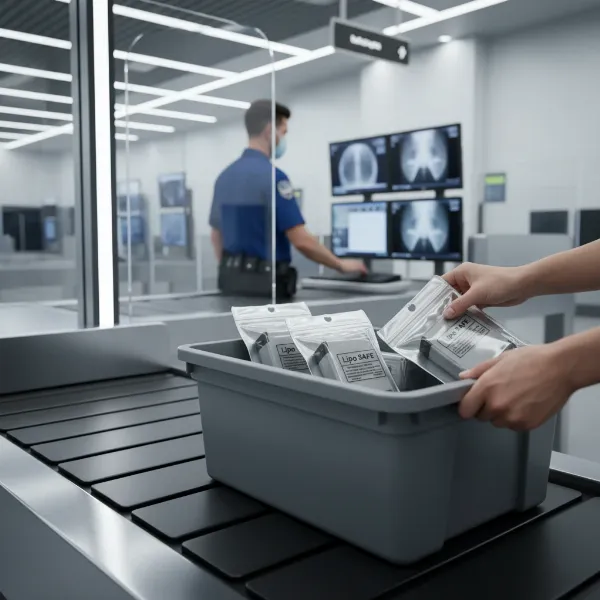 Drone batteries in clear bags going through airport security checkpoint with TSA officer
Airline-Specific Policies: Always Check Before You Fly
While TSA and FAA guidelines provide a foundational framework for drone travel, individual airlines often impose their own specific rules, which can sometimes be more restrictive. It is absolutely essential to check with your chosen airline well in advance of your travel date. Their policies can cover aspects such as the maximum size and weight of carry-on items, which can impact whether your drone case fits in the overhead bin or under the seat.
For example, an airline might state that a drone can be carried on if its dimensions (or its box’s dimensions) are less than 22 x 14 x 9 inches (56 x 36 x 23 centimeters). Some carriers, like American Airlines, permit drones but strictly adhere to the 160 Wh battery limit for attached batteries and require spare batteries in carry-on. Ryanair, on the other hand, explicitly states that drones are not permitted in checked baggage at all and that any drone batteries exceeding 100 Wh cannot be carried onboard. These variations highlight why direct communication with your airline is non-negotiable for a hassle-free experience.
International Drone Travel: Beyond National Borders
Traveling internationally with a drone introduces another layer of complexity: country-specific drone laws. The regulations for drone operation vary dramatically from one nation to another, and what’s permissible in your home country might be illegal or require special permits elsewhere. Failing to research and comply with these local laws can lead to severe penalties, including fines, drone confiscation, or even legal action.
Before planning any international drone adventure, meticulously research the drone laws of your destination country and any transit countries. Key areas to investigate include:
- Import Restrictions: Some countries prohibit the importation of drones entirely.
- Registration Requirements: Many nations require all drones, even recreational ones, to be registered with their civil aviation authority.
- Flight Zones: Understand designated no-fly zones (e.g., near airports, government buildings, national parks, military installations) and restricted areas.
- Permits and Licenses: Commercial use almost always requires permits, but even recreational flying might demand a permit or a local drone operator’s license.
- Privacy Laws: Be aware of privacy regulations regarding filming individuals or private property.
“The biggest mistake international drone travelers make isn’t with batteries, but with ignoring local flight laws until they arrive. A quick search can save your trip.” – Alex Chen, International Drone Law Specialist
The International Air Transport Association (IATA) provides general guidelines for the safe transport of dangerous goods, including lithium batteries, which most airlines follow. However, local aviation authorities and customs departments have the final say regarding drone entry and operation within their borders.
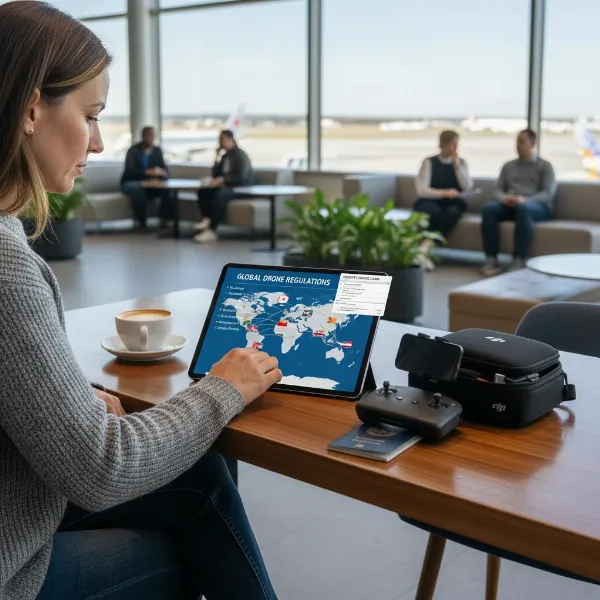 Traveler researching drone laws for international destinations on a tablet with world map and passport
Preparing Your Drone for Air Travel: Packing and Protection
Proper packing is vital for safeguarding your drone during its journey. Start by disassembling your drone as much as possible, removing propellers, landing gear (if detachable), and the gimbal guard. This minimizes strain on delicate parts. Always use a dedicated drone carry case, ideally one with custom foam inserts, to securely cradle each component. Hard cases offer the best protection against impacts and pressure changes during flight.
Crucially, remove all lithium-ion batteries from your drone and any accessories. Even if an airline might allow an attached battery in carry-on, separating them is the safest and most universally accepted practice. As mentioned, these detached batteries must be individually protected in LiPo-safe bags or cases to prevent short circuits. It’s also a good practice to discharge your drone batteries to around 30-50% for air travel, as fully charged batteries can pose a higher fire risk if damaged.
Pack your drone’s charging cables, remote controller, and any other non-battery accessories in either your carry-on or checked luggage, according to your preference and the airline’s carry-on size limitations. Many drone pilots prefer to keep the controller in carry-on for quick access and to prevent damage.
Essential Drone Travel Accessories
Equipping yourself with the right accessories can significantly enhance your drone travel experience, making it safer and more convenient. Beyond the drone itself, consider these vital additions:
- LiPo Safe Bags: These fire-resistant bags are a non-negotiable item for safely transporting your lithium-ion batteries. They help contain a battery fire if one occurs, protecting your other belongings and the aircraft.
- Robust Drone Carry Case: Whether a hardshell case or a well-padded backpack, a dedicated case is essential. It protects your drone from physical shocks, moisture, and dust, ensuring it arrives in perfect working condition. Look for cases designed for your specific drone model.
- Extra Batteries (within limits): While adhering to battery quantity limits, extra batteries are crucial for extending your flight time at your destination. Ensure they are packed correctly in LiPo safe bags.
- Portable Charging Hub/Power Bank: A compact charging solution can be invaluable for topping up batteries on the go, especially when power outlets are scarce. Ensure any power bank also complies with airline battery regulations.
- High-Capacity SD Cards: Don’t let a full memory card cut short your aerial adventures. Carry several high-capacity, fast-read/write SD cards to capture all your footage.
- Lens Cleaning Kit: Dust and smudges can ruin aerial shots. A small cleaning kit will keep your drone’s camera lens pristine.
Troubleshooting and Special Considerations at the Airport
Even with meticulous planning, airport experiences can be unpredictable. Be prepared for potential interactions with TSA officers or customs agents. TSA has the final say on what is allowed through a checkpoint. Having your drone and batteries easily accessible in your carry-on for inspection can expedite the screening process. If asked, calmly explain what the items are. You may also want to print out or save relevant TSA and airline regulations on your phone for quick reference, though a polite demeanor is usually more effective.
For international travel, be aware of customs declarations. Some countries require you to declare your drone upon entry. Always declare truthfully to avoid complications. Moreover, remember that drone usage on board a flight is strictly prohibited. Keep your drone powered off and securely stowed for the entire duration of the flight.
Conclusion
Traveling with your drone can unlock incredible photographic opportunities and add a unique dimension to your adventures. However, it requires careful preparation and strict adherence to TSA and airline regulations, with particular attention to lithium-ion batteries. Always pack your drone’s batteries in your carry-on, ensure they are individually protected, and verify their Watt-hour ratings to comply with quantity limits. Remember that airline policies can vary, so a quick check with your carrier is always a smart move. By understanding and respecting these guidelines, you can ensure your drone travels safely alongside you, ready to capture stunning moments at your destination. What incredible aerial perspectives are you excited to capture on your next journey?
Frequently Asked Questions
Can I put my drone in checked luggage?
|
Our Picks for the Best Drone in 2026
As an Amazon Associate I earn from qualifying purchases.
|
||
| Num | Product | Action |
|---|---|---|
| 1 | DJI Air 3S Fly More Combo (RC 2 Screen Remote Controller), Drone with 1" CMOS Wide-Angle & Medium Tele Camera for Adults, 4K/60fps, Omnidirectional Sensing & 3 Batteries for Extended Flight Time |

|
| 2 | Drone with Camera 1080P HD FPV Foldable Mini Drone for Beginners Kids Adults, Drone with One Key Take Off/Landing, Gesture Selfie, Altitude Hold, 3D Flip, Easy to Fly, 2 Batteries, Toys for Boys Girls |
|
| 3 | Drone with Camera - Drone with Screen on Controller for Beginners, Foldable Remote Control Quadcopter with Gesture Control, 3D Flip, One Key Start, Emergency Stop, 2 Batteries, Easier to use to use |
|
| 4 | DJI Mini 3 Fly More Combo (DJI RC), Drones with Camera for Adults 4K, 3 Batteries for 114-min Flight Time, Vertical Shooting, 32800ft (10km) Video Transmission, Lightweight Mini Drone for Beginners |
|
| 5 | Drone with 1080P Camera - Foldable Remote Control Quadcopter with Gesture Control, 3D Flip, One Key Start, Emergency Stop, 2 Batteries, Easier to use, Toy for Kids Adult Beginners |
|
| 6 | DJI Mini 4K, Drone with 4K UHD Camera for Adults, Under 249 g, 3-Axis Gimbal Stabilization, 10km Video Transmission, Auto Return, Wind Resistance, 1 Battery for 31-Min Max Flight Time, Intelligent |
|
| 7 | GPS Drones with Camera for Adults 4K, FPV Drone Under 249g with Brushless Motor, GPS Auto Return, Follow Me, Circle Fly, Waypoint Flight, Foldable Drone with Gesture Control, 46Mins with 2 Batteries |
|
| 8 | Drone with Camera, Drones for Adults and Beginners, 1080P HD FPV Foldable Mini Drones for Kids, with 2 Batteries, Carrying Case, Trajectory Flight, Gravity Control, One-Key Takeoff/Landing, 360° Flip, Toys for Gift |
|
| 9 | DJI Mini 4K Camera Drone Combo, Drone with 4K UHD Camera for Adults, Under 249 g, 3-Axis Gimbal Stabilization, 10km Video Transmission, Auto Return, 2 Batteries for 62-Min Max Flight Time, QuickShots |
|
| 10 | Drone with Camera for Adults 4K, Brushless Motor Drones for Kids Beginners, 60 Mins Flight, 130° Lens, FPV Foldable RC Quadcopter, Gesture Photography, Toys Gifts for Teen Boys Girls, Black |
|
You can put the drone’s body in checked luggage, but it is generally not recommended due to the risk of damage. Crucially, all lithium-ion batteries must be removed from the drone and packed exclusively in your carry-on baggage to comply with safety regulations.
How many drone batteries can I take on a plane?
For batteries under 100 Wh, there’s typically no strict limit for personal use, but they must be individually protected. For batteries between 101-160 Wh, you are usually limited to two spare batteries, requiring airline approval and individual protection, all in your carry-on.
What are Watt-hours (Wh), and why are they important for drone travel?
Watt-hours (Wh) measure a battery’s energy capacity. They are critical because aviation regulations categorize lithium-ion batteries based on their Wh rating to manage fire risks. Higher Wh batteries have stricter limits or are prohibited from air travel.
Do I need to discharge my drone batteries before flying?
It’s a recommended best practice to discharge your lithium-ion drone batteries to about 30-50% before air travel. This reduces the risk of thermal runaway if a battery is accidentally damaged during transit, enhancing overall safety.
What if my drone battery is over 160 Wh?
If your drone battery exceeds 160 Wh, it is generally prohibited from passenger aircraft, both in carry-on and checked luggage. Such high-capacity batteries usually require specialized cargo shipping and cannot travel with you on a commercial flight.