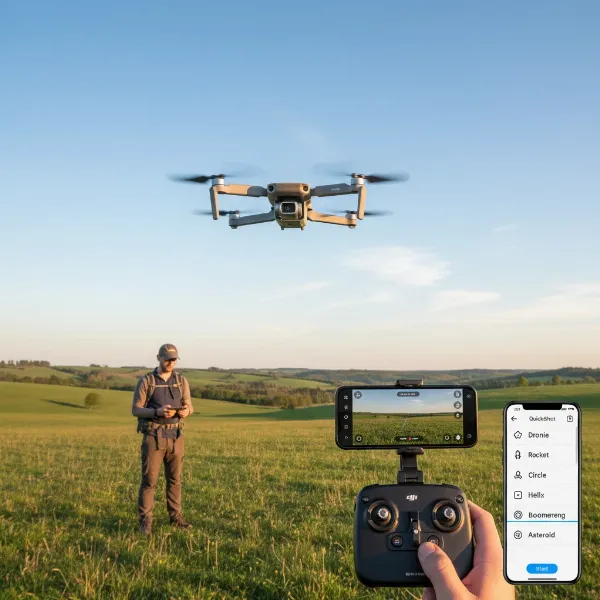
For years, DJI has been the undisputed king of consumer drones, setting the benchmark for aerial photography and videography. But what if a formidable challenger emerged, offering premium features and an uncompromising flight experience that could genuinely rival the best? Enter the Autel Evo Lite+, a drone that has captivated the prosumer market with its impressive specifications, particularly its innovative variable aperture camera and extended flight capabilities. Is this the drone that finally challenges DJI’s reign? Let’s dive into an in-depth review to uncover if the Autel Evo Lite+ is truly a worthy competitor.
What is the Autel Evo Lite+? Overview of Autel’s Prosumer Offering
The Autel Evo Lite+ is a sophisticated foldable drone designed for serious aerial creators, positioning itself firmly in the prosumer segment. Autel Robotics, a company known for its commitment to innovation and user freedom, engineered the Lite+ to deliver high-end imaging capabilities and robust flight performance. Unlike some competitors that prioritize ultra-light designs, the Lite+ boasts a sturdier airframe, allowing it to handle more demanding flight conditions.
At its core, the Lite+ features a powerful 1-inch 20-megapixel CMOS sensor capable of capturing stunning 6K video. Its distinguishing characteristic is a variable aperture lens, a feature typically found in much more expensive drones, providing unparalleled flexibility in diverse lighting scenarios. Coupled with impressive battery life and a robust transmission system, the Autel Evo Lite+ is crafted for those who demand precision, quality, and an unhindered aerial experience.
Autel Evo Lite+ vs. DJI Air 2S: A Head-to-Head Battle
When evaluating the Autel Evo Lite+, its primary rival, the DJI Air 2S, inevitably comes into focus. Both drones offer professional-grade imaging and flight stability, yet they cater to slightly different priorities. The Lite+ aims to surpass the Air 2S in specific high-value features, while DJI maintains its reputation for polished user experience and comprehensive safety systems.
Here’s a direct comparison of their key attributes:
| Feature | Autel Evo Lite+ | DJI Air 2S |
|---|---|---|
| Camera Sensor | 1-inch 20MP CMOS | 1-inch 20MP CMOS |
| Aperture | Variable f/2.8 – f/11 | Fixed f/2.8 |
| Max Video Resolution | 6K (5472×3076) @ 30fps | 5.4K (5472×3078) @ 30fps |
| Max Video Bitrate | 120Mbps | 150Mbps |
| Video Color Depth | 8-bit (Log profile via update) | 10-bit Dlog-M |
| Low-Light Performance | Superior (Night Scene mode up to ISO 48000) | Excellent |
| Flight Time (Advertised) | 40 minutes | 31 minutes |
| Wind Resistance | 12m/s (Level 6) | 10.7m/s (Level 5) |
| Obstacle Avoidance | 3-way (front, back, bottom) – stops | 4-way (front, back, bottom, top) – navigates |
| Transmission System | SkyLink (12km FCC, 2.7K live view up to 1km) | OcuSync 3.0 (12km FCC, 1080p live view) |
| Weight | 835g | 595g |
| Geofencing | Less restrictive (user responsible) | Strict |
| Price (Standard) | Generally higher | Generally lower |
Pros and Cons of the Autel Evo Lite+
Understanding the strengths and weaknesses of the Autel Evo Lite+ is crucial for any potential buyer. It offers distinct advantages that could sway professionals, while also presenting areas where DJI currently holds an edge.
Advantages:
- Exceptional Camera Performance: The Autel Evo Lite+ truly shines with its camera. The 1-inch 20MP sensor delivers incredibly sharp, vibrant images and detailed 6K video. Its standout feature, the variable aperture (f/2.8 to f/11), offers unparalleled control over exposure and depth of field, negating the constant need for ND filters in changing light conditions. Furthermore, its advanced Night Scene mode makes it a top performer in low-light environments, capturing clear footage with minimal noise. For photographers, the ability to shoot DNG RAW files provides extensive post-processing flexibility.
- Extended Flight Time and Robust Build: With an advertised flight time of up to 40 minutes from its large 6175 mAh battery, the Lite+ consistently outperforms many rivals in real-world endurance. This extended duration means more time in the air capturing the perfect shot and less time worrying about battery swaps. Its robust airframe also contributes to superior wind resistance (rated at 12m/s), providing stable flight even in challenging weather conditions, which is essential for professional applications.
- Unrestricted Flight Experience: One of Autel’s most celebrated philosophies is its less restrictive approach to geofencing. This empowers pilots with greater freedom to fly in areas that might be restricted by other brands, though users are always responsible for adhering to local aviation regulations. This freedom can be a significant draw for experienced pilots who value autonomy.
- Solid Transmission Range and Video Feed: The SkyLink transmission system ensures a reliable connection up to 12km (FCC), and notably, it provides a crisp 2.7K live video feed for up to 1km. This high-resolution preview enhances the piloting experience, allowing for more precise framing and detailed monitoring of your shots in real-time, even at considerable distances.
|
Our Picks for the Best Drone in 2026
As an Amazon Associate I earn from qualifying purchases.
|
||
| Num | Product | Action |
|---|---|---|
| 1 | Drone with Camera 1080P HD FPV Foldable Mini Drone for Beginners Kids Adults, Drone with One Key Take Off/Landing, Gesture Selfie, Altitude Hold, 3D Flip, Easy to Fly, 2 Batteries, Toys for Boys Girls |

|
| 2 | DJI Mini 4K Camera Drone Combo, Drone with 4K UHD Camera for Adults, Under 249 g, 3-Axis Gimbal Stabilization, 10km Video Transmission, Auto Return, 2 Batteries for 62-Min Max Flight Time, QuickShots |
|
| 3 | DJI Air 3S Fly More Combo (RC 2 Screen Remote Controller), Drone with 1" CMOS Wide-Angle & Medium Tele Camera for Adults, 4K/60fps, Omnidirectional Sensing & 3 Batteries for Extended Flight Time |
|
| 4 | DJI Mini 3 Fly More Combo (DJI RC), Drones with Camera for Adults 4K, 3 Batteries for 114-min Flight Time, Vertical Shooting, 32800ft (10km) Video Transmission, Lightweight Mini Drone for Beginners |
|
| 5 | Drone with Camera - Drone with Screen on Controller for Beginners, Foldable Remote Control Quadcopter with Gesture Control, 3D Flip, One Key Start, Emergency Stop, 2 Batteries, Easier to use to use |
|
| 6 | Drone with Camera for Adults 4K, Brushless Motor Drones for Kids Beginners, 60 Mins Flight, 130° Lens, FPV Foldable RC Quadcopter, Gesture Photography, Toys Gifts for Teen Boys Girls, Black |
|
| 7 | DJI Mini 4K, Drone with 4K UHD Camera for Adults, Under 249 g, 3-Axis Gimbal Stabilization, 10km Video Transmission, Auto Return, Wind Resistance, 1 Battery for 31-Min Max Flight Time, Intelligent |
|
| 8 | GPS Drones with Camera for Adults 4K, FPV Drone Under 249g with Brushless Motor, GPS Auto Return, Follow Me, Circle Fly, Waypoint Flight, Foldable Drone with Gesture Control, 46Mins with 2 Batteries |
|
| 9 | Drone with 1080P Camera - Foldable Remote Control Quadcopter with Gesture Control, 3D Flip, One Key Start, Emergency Stop, 2 Batteries, Easier to use, Toy for Kids Adult Beginners |
|
| 10 | Drone with Camera, Drones for Adults and Beginners, 1080P HD FPV Foldable Mini Drones for Kids, with 2 Batteries, Carrying Case, Trajectory Flight, Gravity Control, One-Key Takeoff/Landing, 360° Flip, Toys for Gift |
|
Disadvantages:
- Obstacle Avoidance Limitations: While the Autel Evo Lite+ features 3-way obstacle avoidance (front, back, and bottom), its system primarily functions by stopping the drone when an obstruction is detected. This differs from more advanced systems, like DJI’s 4-way avoidance, which can often intelligently navigate around obstacles. The absence of top or side sensors also means less comprehensive protection in complex environments.
- Controller and App Experience: The physical design of the Lite+ controller, though comfortable to hold, can feel less refined compared to DJI’s offerings. It lacks a built-in screen, relying solely on your smartphone, and doesn’t offer elegant storage solutions for its removable control sticks or phone connection cables. The Autel Sky app, while functional, has been noted for its somewhat scattered interface and occasional quirks, sometimes requiring extra taps to access certain modes or resetting user preferences after firmware updates.
- Video Color Depth: The Lite+ records video at 8-bit color depth, in contrast to the DJI Air 2S’s 10-bit Dlog-M. While firmware updates have introduced a flat Log profile for editing flexibility, 8-bit footage offers fewer color grading possibilities in post-production compared to 10-bit, which captures a significantly wider color spectrum. This might be a limiting factor for high-end videographers demanding maximum color fidelity.
- Price Point: Generally, the Autel Evo Lite+ comes with a higher price tag than a comparable DJI Air 2S standard package. While the “Premium Bundle” offers excellent value with multiple batteries and ND filters, the initial investment can be a barrier for those on a tighter budget.
Key Features and What They Mean for You
The Autel Evo Lite+ packs a suite of features designed to enhance the aerial imaging experience. Understanding these capabilities helps appreciate its position in the competitive drone market.
Variable Aperture: A Game-Changer for Aerial Photography
The variable aperture, adjustable from f/2.8 to f/11, is arguably the Autel Evo Lite+’s most significant advantage. For photographers, this means being able to control exposure precisely, allowing for shallower depth of field at wider apertures or sharper, more detailed landscapes at narrower ones. For videographers, it’s invaluable for maintaining the desired shutter speed (often double your frame rate) in varying light conditions without resorting to physically swapping Neutral Density (ND) filters. This significantly streamlines the workflow and ensures optimal exposure on the fly, making it an indispensable tool for dynamic shooting environments.
6K Camera: Capturing Every Detail
Equipped with a 1-inch 20-megapixel CMOS sensor, the Autel Evo Lite+ can record video at an impressive “6K” resolution (5472×3076) at 30 frames per second, along with 4K at 60fps and 1080p at 120fps for slow-motion effects. While the 6K resolution is technically slightly below true 6K, it still delivers stunning detail, clarity, and vibrant colors straight out of the camera. Photographers will appreciate the high-resolution DNG RAW photos (5472×3648) that allow for extensive post-processing. The camera’s low-light capabilities, especially with the Night Scene mode and an ISO range extending to 48000, ensure excellent performance even after sunset.
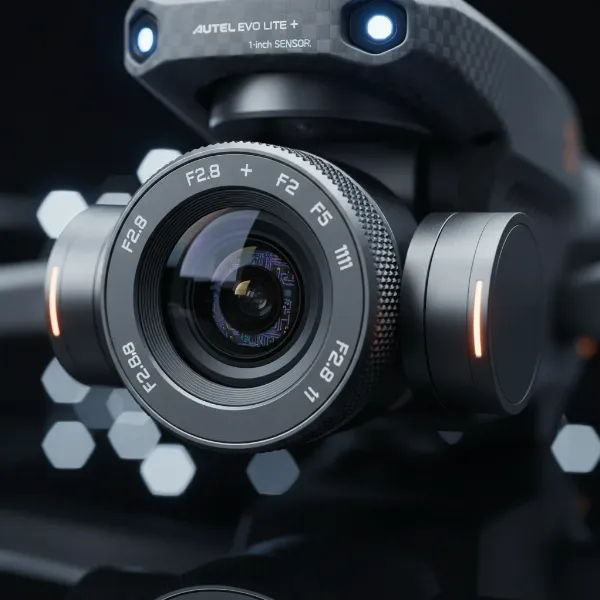 Autel Evo Lite+ camera lens with variable aperture mechanism for detailed aerial photography
Battery Life & Flight Modes: Endurance Meets Versatility
The Lite+ boasts an impressive 40-minute advertised flight time, supported by its substantial 6175 mAh battery. In practical terms, pilots can expect 32-36 minutes of useful flight, which is still significantly more than many drones in its class. This extended endurance minimizes interruptions and maximizes creative opportunities during a single flight session. The drone also offers various flight modes: Ludicrous Mode for high-speed dynamic shots (up to 40mph/64km/h), Standard Mode for balanced control (22mph), and Smooth Mode for cinematic footage (11mph), allowing pilots to adapt to any shooting scenario.
Obstacle Avoidance System: Safety in Three Directions
The Autel Evo Lite+ integrates a 3-way obstacle avoidance system with sensors located at the front, back, and bottom of the drone. These sensors actively detect obstructions and will prompt the drone to stop, preventing potential collisions. While it does not offer the advanced autonomous navigation around obstacles seen in some DJI models, it provides a crucial layer of safety, giving pilots greater confidence, especially when flying in moderately complex environments. Autel has also indicated future firmware updates could enhance these capabilities.
Autel Sky App & Smart Features: Tools for Creative Control
The Autel Sky app serves as the central control hub for the Evo Lite+. It offers a range of intelligent features and QuickShot modes like Rocket, Orbit, Flick, and Fade Away, which enable cinematic shots with minimal effort. The app also includes subject tracking, allowing the drone to follow a designated subject, though initial versions focused on human subjects. Autel consistently releases firmware updates that expand the app’s functionality, including new tracking capabilities and faster Wi-Fi file transfer. For advanced users, the app provides essential photography tools like a histogram and zebra patterns for exposure monitoring.
Who Should Buy the Autel Evo Lite+?
Deciding between the Autel Evo Lite+ and its competitors often comes down to individual needs and priorities.
- Professional Photographers and Videographers will find immense value in the Lite+. Its variable aperture, superior low-light performance, and DNG RAW capabilities provide the control and quality essential for high-level content creation. If you frequently shoot in varied lighting, appreciate rich colors straight out of the camera, and perform extensive post-processing, the Lite+ is an excellent choice.
- Pilots Prioritizing Flight Freedom will gravitate towards the Autel Evo Lite+ due to its generally less restrictive approach to geofencing. This allows for greater operational flexibility in diverse locations, provided you adhere to local regulations.
- Users Demanding Extended Flight Times and Robustness will appreciate the Lite+’s long battery life and sturdy build. If you require longer airtime for extensive shoots or often fly in moderately windy conditions, the Lite+ offers exceptional endurance and stability.
- Prosumers Seeking a High-Value Alternative to DJI’s premium offerings will find the Lite+ an attractive proposition. While it might have a slightly higher upfront cost for the basic package, the Premium Bundle, including multiple batteries and ND filters, often presents superior overall value compared to similarly equipped DJI packages.
Conversely, those who prioritize the most advanced obstacle avoidance with autonomous navigation, a highly polished and streamlined app experience, or a more budget-friendly entry point might lean towards a DJI Air 2S. Beginners might also find the DJI ecosystem slightly more intuitive to start with.
Tips for Using and Maintaining Your Autel Evo Lite+
To ensure your Autel Evo Lite+ delivers optimal performance and lasts for years, follow these essential tips:
- Perform Pre-Flight Checks: Always inspect your drone before each flight. Check propellers for damage, ensure the battery is fully charged and securely seated, and verify that the gimbal guard is removed.
- Choose Safe Flying Locations: Always be aware of your surroundings, local airspace regulations, and weather conditions. Avoid flying near airports, dense crowds, or in strong winds beyond the drone’s rated resistance.
- Keep Firmware Updated: Autel frequently releases firmware updates that improve performance, add new features, and enhance safety. Regularly check the Autel Sky app for the latest updates and install them promptly. Remember that updates might reset some custom settings, so re-verify your preferences after each update.
- Proper Battery Care: Store batteries at roughly 50-60% charge if not using them for extended periods. Avoid over-discharging or overcharging. Allow batteries to cool down before recharging after a flight.
- Regular Cleaning and Maintenance: Keep the camera lens clean using a microfiber cloth. Periodically clean the drone’s body and motors to prevent dust and debris buildup. Store the drone in a protective case when not in use to prevent physical damage.
Conclusion
The Autel Evo Lite+ has firmly established itself as a formidable contender in the prosumer drone market, offering a compelling blend of advanced camera technology, robust flight performance, and user-centric freedom. Its variable aperture camera, extended flight times, and impressive low-light capabilities are significant draws for discerning photographers and videographers who demand creative control and reliability. While the DJI Air 2S remains a highly capable drone, excelling in certain areas like autonomous obstacle avoidance and app polish, the Lite+ carved out its niche by offering a distinct value proposition, particularly for those prioritizing imaging flexibility and uninhibited flight.
Ultimately, the Autel Evo Lite+ isn’t just a strong alternative; it’s a drone that commands respect, pushing the boundaries of what a prosumer drone can achieve. Are you ready to experience the freedom and photographic power that the Autel Evo Lite+ brings to the skies?
Frequently Asked Questions
Is the Autel Evo Lite+ better than the DJI Air 2S?
Whether the Autel Evo Lite+ is “better” than the DJI Air 2S depends on your specific needs. The Lite+ excels with its variable aperture, superior low-light camera performance, longer flight times, and less restrictive geofencing. However, the Air 2S offers more refined obstacle avoidance, a more polished app experience, 10-bit video, and is often more beginner-friendly and budget-conscious.
What is the flight time of the Autel Evo Lite+?
The Autel Evo Lite+ boasts an impressive advertised flight time of up to 40 minutes on a single charge. In real-world flying conditions, users can typically expect a practical flight duration of between 32 to 36 minutes, which is still excellent for a drone in its class.
Does the Autel Evo Lite+ have geofencing restrictions?
Compared to DJI drones, the Autel Evo Lite+ has traditionally had fewer geofencing restrictions, offering pilots greater flexibility in where they can fly. However, it is crucial for every pilot to understand and adhere to all local aviation laws and regulations, as you are ultimately responsible for safe and legal operation.
Is the Autel Evo Lite+ a good drone for beginners?
While the Autel Evo Lite+ is a very capable drone, its advanced features and slightly less refined app experience compared to DJI might make it a steeper learning curve for absolute beginners. New pilots might find the DJI Air 2S more intuitive and user-friendly for their initial drone flying experiences, though the Lite+ is certainly manageable for those willing to learn.
What kind of camera sensor does the Autel Evo Lite+ have?
The Autel Evo Lite+ is equipped with a high-quality 1-inch 20-megapixel CMOS sensor. This large sensor size is key to its exceptional image quality, excellent dynamic range, and superior low-light performance, allowing it to capture detailed photos and stunning 6K video even in challenging conditions.