Imagine soaring through breathtaking mountain trails, conquering challenging descents, and effortlessly capturing every thrilling moment from a dynamic aerial perspective. This isn’t a fantasy; it’s the reality enabled by advanced follow-me drones, purpose-built to be your personal aerial cameraman. For mountain biking enthusiasts, these intelligent flying companions revolutionize content creation, allowing you to focus entirely on your ride while the drone autonomously films your adventure with cinematic precision.
What is a Follow-Me Drone? The Technology Behind Autonomous Tracking
A follow-me drone is essentially an unmanned aerial vehicle (UAV) equipped with sophisticated technology that allows it to autonomously track and film a designated subject. These drones act as your personal flying camera crew, maintaining a set distance and angle while you perform your activity. This hands-free operation is a game-changer for solo athletes, particularly mountain bikers, who want to capture dynamic footage without the distraction of manual drone control.
The core of a follow-me drone lies in its tracking technology, primarily relying on two main methods: GPS tracking and vision-based tracking, often referred to as ActiveTrack or DynamicTrack. GPS tracking uses satellite positioning to follow the coordinates of a designated target, which is effective in open environments. However, for the intricate and often obstructed paths of mountain biking, vision-based systems are superior. These advanced drones use a combination of vision sensors, recognition technology, and complex algorithms to detect and track a subject in real-time, understanding how the subject moves within the frame. This allows for more precise and reliable tracking, especially when navigating around trees, rocks, and varied terrain, ensuring you stay in focus even in challenging conditions.
Why Mountain Bikers Need Follow-Me Drones: Advantages on the Trail
For mountain bikers, follow-me drones unlock a new dimension of content creation and personal enjoyment. The primary advantage is the ability to capture stunning, professional-quality aerial footage entirely hands-free. You can immerse yourself in the ride, focusing on tricky descents or technical climbs, while your drone intelligently records every turn, jump, and scenic vista.
These drones deliver cinematic shots that would traditionally require a dedicated film crew and expensive equipment. They can hover above, track from the side, or follow from behind, providing unique perspectives that highlight the steepness and ruggedness of trails in a way a helmet cam simply cannot. Whether you’re a professional rider looking to analyze your technique, a content creator building a following, or simply an enthusiast wanting to immortalize your adventures, a follow-me drone is an indispensable tool. It empowers solo riders to produce captivating videos, turning every trail into a potential movie set.
Key Features to Look for in a Mountain Biking Follow-Me Drone
Choosing the best follow-me drone for mountain biking requires a keen eye for features that perform well in dynamic and often challenging outdoor environments. A drone designed for action sports needs to be robust, intelligent, and capable of keeping up with fast-paced movement while navigating obstacles. Prioritizing these key features will ensure your aerial companion enhances, rather than hinders, your biking experience.
Advanced Obstacle Avoidance
|
Our Picks for the Best Drone in 2026
As an Amazon Associate I earn from qualifying purchases.
|
||
| Num | Product | Action |
|---|---|---|
| 1 | DJI Mini 3 Fly More Combo (DJI RC), Drones with Camera for Adults 4K, 3 Batteries for 114-min Flight Time, Vertical Shooting, 32800ft (10km) Video Transmission, Lightweight Mini Drone for Beginners |

|
| 2 | DJI Air 3S Fly More Combo (RC 2 Screen Remote Controller), Drone with 1" CMOS Wide-Angle & Medium Tele Camera for Adults, 4K/60fps, Omnidirectional Sensing & 3 Batteries for Extended Flight Time |
|
| 3 | Drone with Camera 1080P HD FPV Foldable Mini Drone for Beginners Kids Adults, Drone with One Key Take Off/Landing, Gesture Selfie, Altitude Hold, 3D Flip, Easy to Fly, 2 Batteries, Toys for Boys Girls |
|
| 4 | DJI Mini 4K, Drone with 4K UHD Camera for Adults, Under 249 g, 3-Axis Gimbal Stabilization, 10km Video Transmission, Auto Return, Wind Resistance, 1 Battery for 31-Min Max Flight Time, Intelligent |
|
| 5 | Drone with Camera - Drone with Screen on Controller for Beginners, Foldable Remote Control Quadcopter with Gesture Control, 3D Flip, One Key Start, Emergency Stop, 2 Batteries, Easier to use to use |
|
| 6 | GPS Drones with Camera for Adults 4K, FPV Drone Under 249g with Brushless Motor, GPS Auto Return, Follow Me, Circle Fly, Waypoint Flight, Foldable Drone with Gesture Control, 46Mins with 2 Batteries |
|
| 7 | Drone with Camera, Drones for Adults and Beginners, 1080P HD FPV Foldable Mini Drones for Kids, with 2 Batteries, Carrying Case, Trajectory Flight, Gravity Control, One-Key Takeoff/Landing, 360° Flip, Toys for Gift |
|
| 8 | Drone with 1080P Camera - Foldable Remote Control Quadcopter with Gesture Control, 3D Flip, One Key Start, Emergency Stop, 2 Batteries, Easier to use, Toy for Kids Adult Beginners |
|
| 9 | DJI Mini 4K Camera Drone Combo, Drone with 4K UHD Camera for Adults, Under 249 g, 3-Axis Gimbal Stabilization, 10km Video Transmission, Auto Return, 2 Batteries for 62-Min Max Flight Time, QuickShots |
|
| 10 | Drone with Camera for Adults 4K, Brushless Motor Drones for Kids Beginners, 60 Mins Flight, 130° Lens, FPV Foldable RC Quadcopter, Gesture Photography, Toys Gifts for Teen Boys Girls, Black |
|
This is arguably the most critical feature for mountain biking. Trails are often flanked by trees, branches, rocks, and other natural obstacles. A drone with 360-degree or omnidirectional obstacle sensing is essential to prevent collisions, ensuring your drone can intelligently detect and bypass objects in its flight path. Systems like Skydio’s 2+ with its six 200-degree cameras are particularly renowned for their superior obstacle avoidance capabilities, minimizing the risk of crashes in dense environments.
Robust Tracking Performance
For mountain biking, the drone needs a highly reliable tracking system that can maintain a lock on a fast-moving subject through varied terrain. Vision-based tracking, such as DJI’s ActiveTrack (versions 4.0 and 5.0) or Autel’s Dynamic Track, is far more effective than basic GPS tracking in complex environments. The ability to follow from multiple angles—front, back, and sides—and even reacquire the subject if momentarily lost, ensures consistent and smooth footage. Look for drones that allow customization of tracking distance and height to achieve your desired shot while maintaining safety.
Superior Camera Quality
The goal is to capture stunning footage, so camera quality is paramount. A drone should offer at least 4K video resolution, with some advanced models featuring 5.1K, 5.4K, or even 8K capabilities. Beyond resolution, consider sensor size (1-inch or 1/1.3-inch CMOS sensors generally offer better low-light performance and dynamic range), and reliable image stabilization via a 3-axis gimbal. Features like HDR video and 10-bit color profiles will further enhance the cinematic quality of your mountain biking clips.
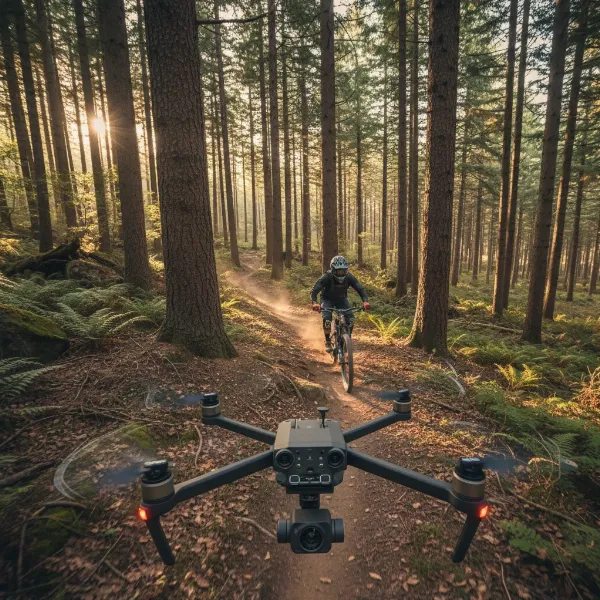 A follow-me drone autonomously tracking a mountain biker on a winding forest trail, capturing dynamic aerial footage.
Extended Flight Time & Portable Design
Mountain biking sessions can be lengthy, so a drone with a flight time of at least 25-30 minutes is highly recommended, with 40-45 minutes being ideal. Carrying multiple spare batteries is also a smart strategy for extended filming. Portability is another key factor; a compact, lightweight drone that can be easily stowed in a backpack without adding significant bulk is preferable for riders venturing into remote areas. Drones under 250g also often avoid certain registration requirements in many regions.
Durability
Given the inherent risks of flying near trails and the potential for unexpected bumps or crashes, a durable drone is a wise investment. While no drone is indestructible, models with robust build quality or protective features can better withstand minor impacts. Some compact drones, like the HoverAir X1 Pro, even feature built-in cages for added protection.
Customization & Ease of Use
The best follow-me drones offer various intelligent flight modes and customization options. Beyond basic follow-me, features like Orbit, Spotlight, or Waypoint tracking allow for more creative and complex shots. Simple, intuitive controls and a user-friendly app interface are crucial, especially if you’re a solo rider who needs to initiate flights quickly and reliably without extensive pre-flight setup.
Top Follow-Me Drones for Mountain Biking: A Detailed Comparison
The market offers several excellent follow-me drones, each with unique strengths. For mountain bikers, the choice often comes down to balancing cutting-edge tracking, camera performance, portability, and budget. Here’s a look at some of the top contenders and their standout features.
Skydio 2+
Often hailed as the pinnacle of autonomous tracking, the Skydio 2+ is a favorite for action sports. It boasts six 200-degree color cameras, providing unmatched 360-degree obstacle avoidance, meaning it “sees everything in every direction” and can intelligently navigate dense environments, making it ideal for forested trails. The Skydio 2+ records in 4K60 HDR and offers up to 27 minutes of flight time. Its optional Beacon accessory extends range and can assist in very dense areas where visual tracking might be momentarily compromised.
DJI Mavic 3 Pro
The DJI Mavic 3 Pro stands out for its exceptional camera system and advanced tracking capabilities. Featuring a custom Hasselblad wide-angle camera and a medium tele camera, it captures breathtaking 5.1K/4K footage. Its ActiveTrack 5.0 system provides smooth, reliable subject tracking and omnidirectional obstacle sensing, ensuring it keeps up with fast-moving bikers while avoiding collisions. With a remarkable flight time of up to 46 minutes, the Mavic 3 Pro offers extended filming opportunities. The Mavic 3 Classic provides a slightly more budget-friendly option with many of the same core tracking and avoidance features, albeit with a single camera.
DJI Air 3
Positioned as a formidable mid-range option, the DJI Air 3 offers a dual-camera system with a wide-angle and a 3x medium telephoto lens, both powered by 1/1.3-inch CMOS sensors. This versatility allows for creative framing, from sweeping wide shots to dynamic close-ups. Like the Mavic series, it features ActiveTrack 5.0 and omnidirectional obstacle sensing, coupled with an impressive 46-minute flight time and the new OcuSync 4.0 transmission system for extended range.
DJI Mini 3 Pro / Mini 4 Pro
For those prioritizing portability, the DJI Mini series, particularly the Mini 3 Pro and Mini 4 Pro, are excellent choices. Weighing under 249g, these drones often bypass registration requirements, making them convenient for travel. The Mini 3 Pro offers 4K HDR video, tri-directional obstacle avoidance, and ActiveTrack 4.0, while the Mini 4 Pro upgrades to ActiveTrack 360° and omnidirectional obstacle sensing with 4K/60fps HDR video, making it a powerful, ultra-light option for dynamic tracking. Both models offer impressive flight times for their size, with the Mini 4 Pro reaching up to 45 minutes with a larger battery.
HoverAir X1 Pro / Max
The HoverAir X1 Pro (and its Max variant) offers a unique, hands-free flying experience. This compact, self-flying drone uses body and face recognition for tracking and requires no controller for its pre-programmed flight patterns (Follow, Sidetrack, Orbit). It’s lauded for its simplicity and portability, making it one of the easiest drones for hands-free filming on flow trails and open terrain. While its 8K video is more “action cam level,” it provides good quality in a durable, cage-protected design, though it may struggle in very tight singletrack or high-speed descents.
Comparison Table of Top Follow-Me Drones for Mountain Biking
| Drone Model | Key Tracking Technology | Obstacle Avoidance | Max Video Resolution | Max Flight Time | Key Strengths |
|---|---|---|---|---|---|
| Skydio 2+ | Skydio Autonomy | 360-degree | 4K60 HDR | 27 min | Best autonomous tracking, superior obstacle avoidance |
| DJI Mavic 3 Pro | ActiveTrack 5.0 | Omnidirectional | 5.1K | 46 min | Professional camera, long flight time, robust tracking |
| DJI Air 3 | ActiveTrack 5.0 | Omnidirectional | 4K100fps HDR | 46 min | Versatile dual-camera, strong all-around performance |
| DJI Mini 4 Pro | ActiveTrack 360° | Omnidirectional | 4K60fps HDR | 34-45 min | Ultra-light, feature-rich, excellent for portability |
| HoverAir X1 Pro | Body/Face Recognition | Limited (forward) | 8K (action cam level) | 20-25 min | Self-flying, extremely portable, user-friendly |
| Autel Evo II Pro | Dynamic Track 2.1 | 360-degree | 6K | 40 min | Good camera control, robust build, alternative to DJI |
Choosing the Right Drone for Your Mountain Biking Adventures
Selecting the perfect follow-me drone involves matching its capabilities to your specific riding style, budget, and filming aspirations. Consider where you typically ride: if your trails are wide-open, a drone with robust GPS tracking might suffice, but for dense, technical singletrack, advanced vision-based obstacle avoidance is non-negotiable.
Your budget will naturally guide your choices, with entry-level options offering solid tracking for casual use, while premium models provide professional-grade camera quality and more sophisticated autonomy. Think about how important video quality is to you versus raw tracking performance and portability. A compact drone like the DJI Mini 4 Pro offers a fantastic balance of features in a travel-friendly package, while the Skydio 2+ excels in pure tracking performance for challenging terrain.
> “For true hands-free mountain biking footage, always prioritize a drone with robust, omnidirectional obstacle avoidance. It’s the difference between capturing an epic ride and collecting drone parts.” – Admin of DroneEar.com, Experienced Drone Technician
Tips for Filming with Your Follow-Me Drone on Mountain Bike Trails
To get the most out of your follow-me drone while mountain biking, a little preparation and understanding of its capabilities go a long way. Before every ride, conduct a thorough pre-flight check, ensuring batteries are charged (including spares), propellers are secure, and the camera lens is clean. Always be aware of local drone regulations and no-fly zones, especially in national parks or protected areas, to ensure a safe and legal flight.
When setting up your drone, choose an open area for takeoff and landing. Understand your drone’s tracking limitations; some models might struggle with very tight turns, sudden changes in speed, or dense overhead canopy. Experiment with different tracking distances and heights to achieve varied and dynamic shots, but always keep safety in mind. Using a dedicated tracking beacon (if your drone supports one) can enhance reliability, especially when visual tracking might be momentarily lost. Remember to monitor battery levels closely, and utilize return-to-home features when power is low.
Conclusion
Follow-me drones have undeniably transformed how mountain bikers can document and share their passion. From capturing exhilarating downhill runs to showcasing the scenic beauty of remote trails, these intelligent aerial companions offer a hands-free solution for creating stunning, cinematic content. The rapid advancements in AI-powered tracking and obstacle avoidance mean that you can focus on the ride of your life while your drone expertly captures every moment.
Whether you’re a seasoned pro seeking the most advanced autonomous tracking or a weekend warrior looking for an easy-to-use, portable option, there’s a follow-me drone engineered to meet your mountain biking needs. By investing in a drone with superior camera quality, extended flight time, and, most importantly, robust obstacle avoidance, you unlock endless possibilities for elevating your aerial adventures. Which follow-me drone will you choose to take your mountain biking footage to new heights?
Frequently Asked Questions
What is the most important feature for a mountain biking follow-me drone?
The most important feature for a mountain biking follow-me drone is advanced omnidirectional obstacle avoidance. Mountain trails are unpredictable and often have dense trees, rocks, and uneven terrain. Superior obstacle sensing ensures the drone can autonomously navigate these complex environments safely, preventing collisions and allowing you to focus on your ride without worry.
Can all follow-me drones track me accurately through dense forests?
No, not all follow-me drones can track accurately through dense forests. Basic GPS-based tracking struggles when satellite signals are obstructed by heavy tree cover. Drones with advanced vision-based tracking systems and 360-degree obstacle avoidance, like the Skydio 2+ or DJI Mavic 3 Pro, are far more capable of navigating and maintaining a lock on you in such complex, obstructed environments.
How long can a follow-me drone typically film a mountain bike ride?
The filming duration of a follow-me drone depends primarily on its battery life. Most modern follow-me drones offer a flight time between 25 to 46 minutes per charge. For extended mountain biking sessions, it’s highly recommended to carry multiple spare batteries to ensure you can capture all the desired footage without interruptions.
Do I need a controller to operate a follow-me drone for mountain biking?
While most advanced follow-me drones from brands like DJI come with a controller and an app for setup and manual intervention, some ultra-compact models, such as the HoverAir X1 Pro, are designed for self-flying hands-free operation without a traditional controller. These drones rely on pre-set flight patterns and body/face recognition for tracking, making them exceptionally user-friendly for solo creators.