Embarking on the drone piloting journey can be exhilarating, yet choosing the right drone often feels overwhelming with countless options available. If you’re considering an entry-level drone that balances affordability with essential features, the Holy Stone HS720 series frequently captures attention. But does it truly deliver for aspiring aerial photographers and hobbyists? This comprehensive review delves into the Holy Stone HS720’s capabilities, performance, and value, helping you decide if it’s the perfect companion for your sky-high adventures.
Holy Stone HS720: An Overview for Aspiring Pilots
The Holy Stone HS720 represents a popular line of consumer drones designed to offer an accessible entry point into the world of aerial photography and videography. These drones, including variations like the HS720E, HS720G, and HS720R, aim to provide core functionalities typically found in more expensive models, such as GPS stabilization and 4K camera capabilities, at a budget-friendly price. While the base HS720 model offers solid performance for its class, newer iterations like the HS720R introduce advanced features such as a 3-axis mechanical gimbal, significantly enhancing video stability. Each model is tailored to meet the needs of beginners and casual flyers who want to explore drone technology without a substantial financial commitment.
What sets the Holy Stone HS720 series apart is its commitment to beginner-friendly operation combined with impressive specifications for its price point. It’s built for those who prioritize ease of use and a lower learning curve, making it an excellent choice for first-time drone owners or those upgrading from toy drones.
Key Specifications of the Holy Stone HS720 Series
Understanding the core specifications helps in evaluating the drone’s capabilities and suitability for different tasks. Here’s a general look at what the Holy Stone HS720 series offers:
- Weight: Approximately 460 grams (for the HS720), placing it above the 249g threshold for FAA registration in many regions.
- Dimensions (Folded): Around 173 x 104 x 56mm, making it highly portable.
- Dimensions (Unfolded): Approximately 336 x 370 x 56mm, providing a stable flight platform.
- Battery: Typically 2800mAh to 3400mAh LiPo (7.4V or 7.6V), offering 22-26 minutes of flight time per battery.
- Camera: Advertised as 4K (3840 x 2160p), with some models featuring a 3-axis mechanical gimbal (HS720R/G) and others relying on Electronic Image Stabilization (EIS) or shock absorption (HS720/E).
- Control Range: Up to 1000 meters (1 km).
- Motors: Equipped with brushless motors for enhanced durability, efficiency, and quieter operation.
- Transmission: 5GHz FPV transmission for live video feed.
|
Our Picks for the Best Drone in 2026
As an Amazon Associate I earn from qualifying purchases.
|
||
| Num | Product | Action |
|---|---|---|
| 1 | DJI Air 3S Fly More Combo (RC 2 Screen Remote Controller), Drone with 1" CMOS Wide-Angle & Medium Tele Camera for Adults, 4K/60fps, Omnidirectional Sensing & 3 Batteries for Extended Flight Time |

|
| 2 | Drone with Camera 1080P HD FPV Foldable Mini Drone for Beginners Kids Adults, Drone with One Key Take Off/Landing, Gesture Selfie, Altitude Hold, 3D Flip, Easy to Fly, 2 Batteries, Toys for Boys Girls |
|
| 3 | DJI Mini 3 Fly More Combo (DJI RC), Drones with Camera for Adults 4K, 3 Batteries for 114-min Flight Time, Vertical Shooting, 32800ft (10km) Video Transmission, Lightweight Mini Drone for Beginners |
|
| 4 | Drone with Camera for Adults 4K, Brushless Motor Drones for Kids Beginners, 60 Mins Flight, 130° Lens, FPV Foldable RC Quadcopter, Gesture Photography, Toys Gifts for Teen Boys Girls, Black |
|
| 5 | Drone with Camera, Drones for Adults and Beginners, 1080P HD FPV Foldable Mini Drones for Kids, with 2 Batteries, Carrying Case, Trajectory Flight, Gravity Control, One-Key Takeoff/Landing, 360° Flip, Toys for Gift |
|
| 6 | Drone with Camera - Drone with Screen on Controller for Beginners, Foldable Remote Control Quadcopter with Gesture Control, 3D Flip, One Key Start, Emergency Stop, 2 Batteries, Easier to use to use |
|
| 7 | DJI Mini 4K, Drone with 4K UHD Camera for Adults, Under 249 g, 3-Axis Gimbal Stabilization, 10km Video Transmission, Auto Return, Wind Resistance, 1 Battery for 31-Min Max Flight Time, Intelligent |
|
| 8 | DJI Mini 4K Camera Drone Combo, Drone with 4K UHD Camera for Adults, Under 249 g, 3-Axis Gimbal Stabilization, 10km Video Transmission, Auto Return, 2 Batteries for 62-Min Max Flight Time, QuickShots |
|
| 9 | GPS Drones with Camera for Adults 4K, FPV Drone Under 249g with Brushless Motor, GPS Auto Return, Follow Me, Circle Fly, Waypoint Flight, Foldable Drone with Gesture Control, 46Mins with 2 Batteries |
|
| 10 | Drone with 1080P Camera - Foldable Remote Control Quadcopter with Gesture Control, 3D Flip, One Key Start, Emergency Stop, 2 Batteries, Easier to use, Toy for Kids Adult Beginners |
|
Unboxing and First Impressions: What’s in the Box?
Upon unboxing the Holy Stone HS720, you’re greeted with a thoughtfully packaged kit that underscores its value proposition. Typically, the package includes the drone itself, a remote controller, usually two intelligent flight batteries, a USB charging cable with a charging hub, a set of spare propellers, a small screwdriver for maintenance, and a well-designed smart carry case. The inclusion of two batteries is a significant advantage, effectively doubling your flight time right out of the box, which is particularly beneficial given the single battery’s moderate flight duration.
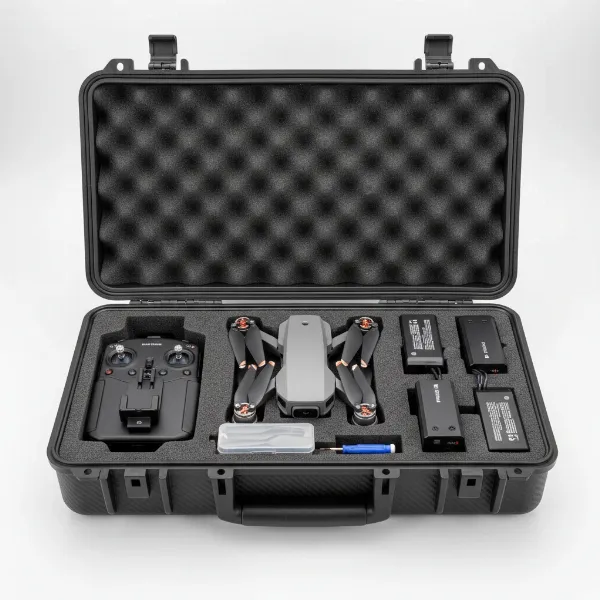 Holy Stone HS720 drone, controller, and accessories neatly arranged in its protective carry case, indicating readiness for travel.
The drone itself often boasts a solid, robust build quality, giving users confidence in its durability for minor bumps and crashes. While the drone feels sturdy, some users note that the accompanying controller might feel less premium, made from a lighter plastic with a potentially awkward phone mounting system that struggles with larger smartphones. Despite this, the controller’s extendable grips generally make it comfortable to hold, especially when a phone is mounted. It’s important to remember that AA batteries for the controller are typically not included, so be sure to have those on hand for your first flight.
Flight Performance and Handling: Is it Easy to Fly?
The Holy Stone HS720 is generally well-regarded for its beginner-friendly flight characteristics, making it an approachable drone for those new to the hobby. The controls are largely responsive and accurate, allowing for a relatively straightforward piloting experience. Equipped with GPS positioning, the drone offers stable hovering capabilities, a crucial feature for capturing steady shots and reducing piloting stress for novices. This GPS functionality also enables useful features like Return to Home (RTH), where the drone automatically flies back to its take-off point in case of low battery or lost signal.
However, even with GPS, some reviews indicate that the HS720 can experience a slight drift when hovering, requiring minor manual adjustments to maintain a perfectly fixed position. While generally good, its flight performance might lack the finesse of more expensive drones, with occasional lag between control input and drone movement when operating at longer distances. The drone offers multiple speed modes (Beginner/Low, Medium, High) to accommodate different skill levels, allowing pilots to gradually increase their confidence. It’s important to note the absence of obstacle avoidance sensors, which means pilots must exercise caution and maintain visual line of sight, especially when flying near obstacles. The HS720’s maximum range is typically around 1 km (0.62 miles), which is adequate for most recreational uses but less than some premium competitors.
Camera Quality and Aerial Cinematography: Capturing Your World
The camera is often a significant deciding factor for drone enthusiasts, and the Holy Stone HS720 series presents a mixed bag. Many models in the HS720 series are advertised with 4K Ultra HD cameras, capable of recording video at 3840 x 2160p. While it does capture 4K footage, the actual video quality is frequently described as mediocre compared to higher-end drones, and some models might not offer “true” cinema-grade 4K output. Photos, in particular, can sometimes appear less sharp than video footage.
A key differentiator within the HS720 lineup is the image stabilization system. Earlier models like the HS720 and HS720E primarily rely on shock absorption or Electronic Image Stabilization (EIS) to reduce camera vibration. While these methods help, they often result in video that can still be shaky, especially in windy conditions or during swift maneuvers. The more advanced HS720R and HS720G models, however, are Holy Stone’s first to feature a 3-axis mechanical gimbal, a significant upgrade that dramatically improves video smoothness and stability. This mechanical gimbal allows for much more professional-looking footage, even during flight. The camera lens is also adjustable up to 90 degrees, either via the remote control or the companion app, providing flexibility in capturing different perspectives.
Beyond basic recording, the Holy Stone HS720 series includes several intelligent flight modes to enhance your aerial cinematography:
- Follow Me: The drone can autonomously track a subject, keeping them in the frame. However, without obstacle avoidance, users must ensure a clear flight path.
- Tap Fly (Waypoint Mode): You can set a custom flight path on your smartphone screen, and the drone will follow it automatically, freeing you to focus on camera operation.
- Point of Interest (Orbit Mode): The drone can circle around a designated point, capturing cinematic orbiting shots.
- Time-lapse: Some newer models, like the HS720R, include a time-lapse feature, adding creative options for capturing dynamic scenes.
Battery Life and Charging: Staying in the Air
Battery performance is a critical aspect of any drone, influencing how much time you can spend capturing footage or enjoying the flight. The Holy Stone HS720 typically comes with intelligent LiPo batteries that offer a decent flight time for its category. Each battery generally provides an advertised flight duration of around 22 to 26 minutes. A major advantage of many Holy Stone HS720 packages is the inclusion of two batteries, effectively extending your total flight time to 44-52 minutes with a quick swap during your flight session. This dual-battery setup mitigates the common frustration of short flight times often associated with budget drones.
However, the convenience of extended flight time is somewhat offset by the charging duration. A single battery can take approximately five hours to fully charge via USB-C. If you’re charging both batteries sequentially, you could be looking at a 10-12 hour wait between comprehensive flight sessions, which can be a drawback for those eager to fly frequently. For this reason, many users recommend purchasing additional batteries if prolonged flight sessions are a priority. To enhance safety and ensure a smooth return, the HS720 features an automatic Return to Home (RTH) function when the battery level drops to 30-40% or if the signal is lost. At these lower battery levels, the drone may also limit its altitude and distance to ensure it has enough power to return safely.
Safety Features and Potential Downsides
While the Holy Stone HS720 aims to be an accessible entry-level drone, it’s important to be aware of its safety features and limitations. Its primary safety mechanism is GPS positioning, which enables stable flight and the crucial Return to Home (RTH) function. This feature ensures the drone can autonomously navigate back to its take-off point in situations like low battery or loss of signal, offering peace of mind, especially for beginners.
However, one of the most significant downsides is the lack of obstacle avoidance sensors. This means the drone cannot automatically detect and maneuver around obstacles, requiring pilots to be vigilant and maintain a clear line of sight, particularly in complex environments. Without this feature, the risk of collisions is higher compared to drones equipped with advanced sensing systems.
Another consideration for HS720 owners is FAA registration. With a typical weight of around 460 grams, the Holy Stone HS720 exceeds the 249-gram threshold that exempts many lightweight drones (like some DJI Mini models) from mandatory registration with aviation authorities in countries like the United States. This adds an extra step and responsibility for the pilot. Furthermore, while the drone itself generally has a solid build, the controller’s design has been criticized for feeling less premium and having an awkward phone mounting system that may not securely hold larger smartphones. Some users have also reported occasional connection issues or drifting, highlighting the importance of pre-flight checks and flying in open areas.
> “For beginners, the Holy Stone HS720 offers a solid foundation for learning drone piloting, but its lack of obstacle avoidance demands a heightened sense of situational awareness from the pilot.” – Admin, DroneEar.com, Drone Expert with 10+ Years Experience
Holy Stone HS720 vs. The Competition (e.g., DJI Mini Series)
When considering a drone like the Holy Stone HS720, it’s almost inevitable to compare it with the market leader, particularly the DJI Mini series (e.g., Mavic Mini, Mini SE, Mini 2). This comparison reveals distinct advantages and trade-offs for each.
| Feature | Holy Stone HS720 (Typical) | DJI Mavic Mini / Mini SE (Typical) |
|---|---|---|
| Price | More affordable | Higher price point |
| Weight | ~460g (Requires FAA registration) | ~249g (Often no registration required) |
| Flight Time (Single Battery) | 22-26 minutes | 30 minutes |
| Max Range | ~1 km (0.62 miles) | ~4 km (2.5 miles) |
| Camera Quality | 4K (3840x2160p), generally mediocre, some with 3-axis gimbal | 2.7K or 4K (for Mini 2/SE), superior image quality, 3-axis gimbal |
| Image Stabilization | Shock absorption/EIS (older models); 3-axis gimbal (HS720R/G) | 3-axis mechanical gimbal (standard) |
| Obstacle Avoidance | None | Downward vision sensors (some models) |
| Build Quality | Solid, sturdy (often metal frame) | Lighter (plastic frame), refined |
| Bundle | Often includes 2 batteries and a carry case | Usually 1 battery (Fly More Combo has more) |
| Reliability | Can experience minor lag or drift | Rock-solid reliability and performance |
| After-sales Support | Varies, generally less robust than DJI | Excellent repair/replacement services |
The Holy Stone HS720 generally offers a more budget-friendly package, often including two batteries and a carry case, which adds significant value. It boasts respectable speed and a sturdy build. However, DJI’s Mini series typically excels in flight range, overall camera quality, and superior image stabilization due to its consistently high-performing 3-axis gimbals. DJI drones are also renowned for their robust reliability, sophisticated software, and comprehensive customer support.
When to choose Holy Stone HS720:
- You are a complete beginner looking to learn the basics of drone piloting without a large investment.
- Your primary need is recreational flying and casual aerial shots, not professional-grade footage.
- Budget is a significant constraint, and you want the most features for your money, including extra batteries and a case.
When to consider DJI Mini Series:
- You prioritize superior camera quality and truly stable, cinematic video.
- You need a longer flight range and more reliable connectivity.
- You prefer a drone under 250g to avoid FAA registration.
- You are willing to invest more for advanced features, refined performance, and excellent after-sales support.
Common Issues and Troubleshooting Tips
Even with its user-friendly design, the Holy Stone HS720, like many drones, can encounter a few common issues. Understanding these and knowing how to troubleshoot them can significantly improve your flying experience.
Camera Not Working
This is a frequent complaint, often stemming from software rather than hardware.
- Fix: Ensure your companion app is updated to the latest version. Some users report better compatibility with iOS devices compared to Android. If the problem persists, reinstalling the app or trying a different compatible smartphone might resolve it.
SD Card Issues (Files Not Showing/Playing)
Users sometimes find recorded files missing or corrupted on their SD card.
- Fix: Always use a Class 10 or higher speed Micro SD card to ensure adequate read/write speeds for 4K video. Crucially, make sure you stop recording before powering off the drone; turning off the drone while still recording can corrupt the video file. If files are still not visible, try inserting the SD card directly into a computer to check if the issue is with the drone’s app or connection.
Wi-Fi / Connection Problems
Intermittent signal loss or poor video feed quality can disrupt flights.
- Fix: Ensure your phone is properly connected to the drone’s Wi-Fi network. Fly in open areas away from strong electromagnetic interference. Make sure the controller’s antennas are oriented correctly (often in a “triangle orientation” for best signal). The HS720R, in particular, has noted improvements in transmission reliability over older models.
Drifting
Despite GPS, the drone might drift slightly when hovering.
- Fix: While minor drifting can occur even with GPS, ensure the drone has a clear view of the sky for optimal satellite acquisition before take-off. Perform compass calibrations in new flight locations or if instructed by the app. Strong winds can also contribute to drifting, so fly in calm conditions.
Video Lag on Live FPV Feed
The live video feed to your smartphone might experience delays.
- Fix: This can be due to environmental interference (5GHz is sensitive to obstacles), phone processing power, or app issues. Try flying closer to the drone, closing other apps on your phone, or ensuring your phone meets the app’s minimum requirements. Recording directly to an SD card on the drone will always yield better quality than the FPV stream.
Erratic Flight Behavior / Unprompted Fly-aways
In rare cases, the drone might behave unpredictably or fly away on its own.
- Fix: This could be due to calibration issues, low battery, or signal loss. Always perform pre-flight checks, including compass calibration and GPS lock. If you experience erratic behavior, land the drone immediately. If a fly-away occurs, the Return to Home (RTH) feature is your best bet, but prevention through careful setup and adherence to flight guidelines is paramount.
Who is the Holy Stone HS720 For?
The Holy Stone HS720 series carves out a niche for a specific type of drone enthusiast, primarily catering to those at the beginning of their aerial journey.
It’s an excellent choice for:
- First-Time Drone Pilots: If you’re completely new to drones and want to learn the basics of flight control, GPS navigation, and simple aerial photography without the fear of damaging an expensive piece of equipment, the HS720 is ideal. Its relatively easy controls and forgiving nature make it a great learning platform.
- Hobbyists on a Budget: For individuals who enjoy recreational flying and capturing casual photos or videos without needing professional-grade output, the HS720 offers significant value. The inclusion of two batteries and a carry case in many bundles makes it a cost-effective package.
- Those Upgrading from Toy Drones: If you’ve mastered smaller, simpler drones and are ready for features like GPS, a better camera, and more stable flight without jumping to a premium brand, the HS720 provides a logical next step.
- Learning Aerial Photography/Videography: While not professional quality, the HS720 (especially models with a mechanical gimbal) allows users to practice framing shots, executing intelligent flight modes, and understanding the principles of drone cinematography.
However, it might not be the best fit for:
- Professional Photographers/Videographers: Individuals requiring cinema-quality 4K footage, RAW photo capabilities, advanced color profiles, or precise, highly stable flight in challenging conditions will likely find the HS720’s camera and flight finesse insufficient.
- Pilots Needing Advanced Safety Features: The absence of obstacle avoidance sensors means pilots must be constantly aware of their surroundings, which might be a deal-breaker for those operating in complex environments or seeking maximum safety features.
- Users Demanding Long Range and Connectivity: While its 1km range is decent, it pales in comparison to drones offering several kilometers of range and more robust, interference-resistant transmission systems.
In essence, the Holy Stone HS720 is a commendable choice for those dipping their toes into the drone world or looking for a fun, feature-rich recreational flyer that won’t break the bank.
Conclusion
The Holy Stone HS720 series stands out as a compelling option for beginners and budget-conscious enthusiasts eager to explore the world of drone flying and aerial photography. It successfully balances affordability with a respectable feature set, including 4K camera capabilities (with some models boasting a 3-axis gimbal), reliable GPS positioning for stable flight, and intelligent flight modes like Follow Me and Tap Fly. The inclusion of two batteries and a protective carry case in many packages significantly enhances its value, offering extended flight times and portability without extra cost.
While it may not compete with premium brands like DJI in terms of absolute camera quality, flight finesse, or advanced obstacle avoidance, the HS720 provides a robust and accessible platform for learning. Its minor drawbacks, such as slow charging times and potential drifting, are often acceptable compromises for its attractive price point. Ultimately, if you’re an aspiring pilot seeking an affordable, feature-packed drone to hone your skills and capture stunning perspectives without a significant investment, the Holy Stone HS720 is a drone worth considering for your journey into the skies. Have you considered how the Holy Stone HS720 might kickstart your aerial adventures?
Frequently Asked Questions
Is the Holy Stone HS720 good for beginners?
Yes, the Holy Stone HS720 is widely considered a good drone for beginners due to its user-friendly controls, GPS-assisted stability, and helpful features like Return to Home. Its affordability also makes it a less intimidating option for new pilots to learn and practice flying.
Does the Holy Stone HS720 have a gimbal?
Some models of the Holy Stone HS720 series, specifically the HS720G and the newer HS720R, feature a 3-axis mechanical gimbal for superior video stabilization. However, older models like the original HS720 and HS720E typically use electronic image stabilization (EIS) or shock absorption, which is less effective than a mechanical gimbal.
What is the flight time of the Holy Stone HS720?
Each intelligent flight battery for the Holy Stone HS720 typically provides 22-26 minutes of flight time. Many packages include two batteries, extending your total flight duration to 44-52 minutes, though you’ll need to land and swap them.
Is the Holy Stone HS720 camera good for photography?
The Holy Stone HS720’s 4K camera is decent for casual aerial photography and videography, especially for its price. However, its image quality is generally considered mediocre compared to professional drones, and photos may lack the sharpness and dynamic range desired by serious photographers.
Does the Holy Stone HS720 require FAA registration?
Yes, the Holy Stone HS720 typically weighs around 460 grams, which is above the 249-gram limit for recreational drones that are exempt from FAA registration in the United States. Therefore, if flying in the US, you will need to register your drone with the FAA.
Does the Holy Stone HS720 have obstacle avoidance?
No, the Holy Stone HS720 series generally does not feature obstacle avoidance sensors. Pilots must manually maintain awareness of their surroundings and avoid obstacles, making it crucial to fly in open, unobstructed areas, especially for beginners.